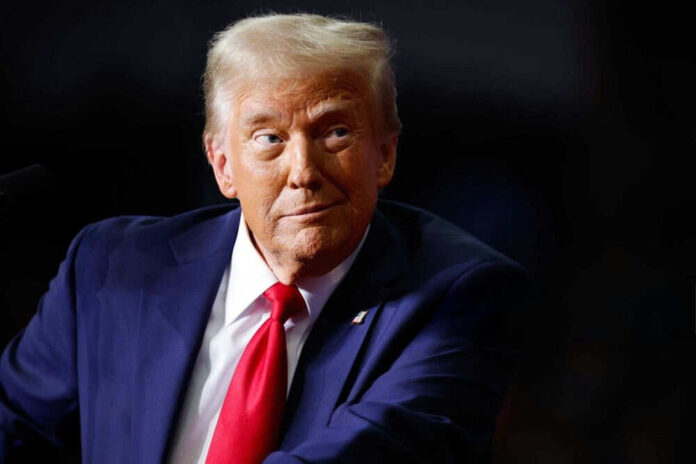
President Donald Trump’s decision to donate his entire first paycheck of his second term for a historic White House renovation sends a bold message about leadership, legacy, and the restoration of American tradition.
Story Highlights
- President Trump donates his first second-term paycheck to the White House Historical Association to fund major renovations, including a new $200 million ballroom.
- The donation continues Trump’s tradition of giving his presidential salary to public causes, distinguishing him from prior administrations’ fiscal practices.
- Renovations are framed as the most significant since the White House’s original construction, with an emphasis on enhancing event capacity for state and public functions.
- The move underscores Trump’s commitment to preserving national heritage without imposing additional taxpayer burden, contrasting sharply with past government overspending.
Trump’s Historic Donation: A Presidential First for White House Renovation
President Trump announced he would donate his first paycheck of his second term directly to the White House Historical Association.
The funds are earmarked to jumpstart a sweeping renovation project, highlighted by the construction of a new, large-scale ballroom—an upgrade Trump has called the most significant since the White House was built.
This gesture follows Trump’s pattern from his first term, where he regularly donated his salary to government agencies, reinforcing his public commitment to fiscal responsibility and service.
Trump gives first paycheck of second term to White House Historical Association for renovations https://t.co/UTeyVxZH8y via @JustTheNews
— FedUp (@FedUp4now2) August 7, 2025
Trump’s donation stands out not only for its symbolism but also for its targeted impact. The White House Historical Association, a nonprofit dedicated to preserving the People’s House, will receive the funds to oversee both the ballroom project and broader renovations.
Trump’s administration has stated that private donors, inspired by his example, are expected to join in funding the $200 million expansion.
This approach offers a solution to the longstanding problem of limited event space for state functions, without adding to the national debt or placing new demands on taxpayers.
Renovations Respond to Decades of Neglected Needs and Public Frustration
The White House has long required expanded facilities, with event planners and staff constrained by current space limitations. Past administrations have discussed the need for a larger ballroom, but none have delivered action at this scale.
Trump’s decisive move comes after years of frustration over government inaction and mismanagement. By leveraging private funds and his own salary, Trump aims to modernize the White House while safeguarding public resources.
The administration’s transparency in communicating the timeline—construction begins September 2025—further contrasts with the opacity often associated with federal projects.
Historically, White House renovations have relied on government funding, with notable examples like the Truman reconstruction. Trump’s direct contribution marks a sharp departure from tradition, reinforcing conservative priorities of limited government and personal initiative.
While some critics question the need for such a grand project, supporters see it as a patriotic act, restoring both the dignity and functionality of the nation’s most important residence.
The White House Historical Association’s partnership ensures the renovations will respect the building’s legacy, even as they introduce modern features to serve future generations.
Legacy, Leadership, and the Future of Public-Private Stewardship
President Trump’s donation is more than a headline—it’s an attempt to set a new precedent for presidential stewardship and private-sector involvement in national heritage.
By channeling personal and private funds into White House preservation, Trump distinguishes his administration from the era of unchecked government spending and bureaucratic delays.
The $200 million ballroom project is expected to generate jobs and fresh opportunities for American workers, delivering tangible economic benefits alongside symbolic value. As construction begins, all eyes will be on the effectiveness and transparency of this public-private approach.
While some historians and preservationists debate the scale of the renovations, the facts remain: Trump’s leadership has mobilized resources for a project that serves both national pride and practical needs.
This bold move aligns with conservative values—protecting taxpayer dollars, honoring America’s history, and demonstrating that real change comes when leaders are willing to put their own skin in the game.
As the White House prepares for its most ambitious upgrade in generations, Trump’s donation stands as both a legacy marker and a challenge to future administrations: lead by example, not by excess.
Sources:
KFOX TV: Trump says he donated his first paycheck to help with White House renovations
NBC Palm Springs: President Trump donates presidential salary to White House renovation projects
White House Historical Association: Sharing White House History about Donald J. Trump