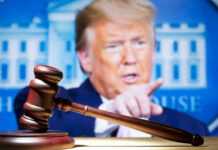
President Donald Trump’s unprecedented federal crackdown on Washington, D.C., crime has exposed yet another scandal in the nation’s capital as he accuses the city of faking statistics to mask public safety failures.
Story Snapshot
- President Trump alleges D.C. officials falsified crime data, launching a federal investigation and law enforcement surge.
- Over 300 arrests have been reported since the deployment of National Guard and federal agents to the nation’s capital.
- D.C.’s official crime statistics show sharp declines, but skepticism about data accuracy divides federal and local authorities.
- No independent evidence yet confirms Trump’s claims, leaving public trust in official statistics and city leadership at stake.
Trump Accuses D.C. of Falsifying Crime Data, Orders Federal Action
President Trump publicly accused Washington, D.C. officials of providing false crime statistics and misleading the American people about the safety of the nation’s capital.
Declaring the city “under serious investigation,” Trump announced a sweeping federal intervention, deploying National Guard troops and federal law enforcement to clamp down on what he described as out-of-control crime.
The president cited more than 300 arrests since the operation began, framing the move as essential to restoring law and order and accountability.
Trump says DC provided false crime statistics, 'under serious investigation' https://t.co/uj3qa5AOJZ
— ConservativeLibrarian (@ConserLibrarian) August 18, 2025
This bold action marks one of the most direct confrontations between the White House and a major U.S. city over public safety reporting. Trump’s approach resonates with Americans frustrated by years of rising violence, soft-on-crime policies, and what many see as leftist leaders downplaying real threats to families and businesses.
The president’s allegations have amplified conservative concerns about government transparency, the integrity of official data, and the dangers of “woke” agendas that prioritize image over security and honest governance.
Official Crime Numbers Drop—But Skepticism Remains
Just days after Trump’s accusations, D.C.’s Metropolitan Police Department released new statistics showing a 7% drop in overall crime from the previous year, with violent crime down 26% and homicides down 11%.
City officials and some independent analysts point to these numbers as proof that public safety is improving and that federal intervention is unnecessary.
However, the president and many of his supporters remain unconvinced, arguing that manipulated data and reclassification tactics can create a misleading sense of security while real threats persist on the streets.
This clash is not merely a matter of numbers but speaks to deeper issues of trust. The American people deserve transparency, and any attempt by local leaders to obscure the truth—whether through creative accounting or selective reporting—undermines the very foundation of public safety and constitutional governance.
With D.C.’s unique status as both a city and the seat of federal power, the stakes are especially high, and the outcome could shape how crime reporting is handled in cities across the country.
Federal-Led Law Enforcement Surge and Political Fallout
Since the deployment of federal officers and the National Guard on August 11, coordinated operations have resulted in over 300 arrests, according to Attorney General Pam Bondi.
Supporters of the crackdown argue that only decisive action can reverse the damage caused by years of lenient policies and bureaucratic denial.
Meanwhile, local officials have pushed back, insisting that federal involvement is unnecessary and that their own strategies are responsible for the recent decline in crime rates. The tension between federal authority and local autonomy is now in the national spotlight, with both sides vying to control the public narrative.
As federal and local law enforcement continue joint operations, D.C. residents and businesses remain caught in the middle. Some welcome the increased presence, believing it will finally bring real change. Others fear deeper mistrust in government, especially if allegations of manipulated data prove unfounded.
Experts note that while D.C.’s crime rates have declined, politicizing public safety data can erode community trust and hinder effective solutions.
The lack of independent evidence supporting Trump’s claims means the controversy will likely persist, keeping crime and data transparency center stage in the nation’s political debate.
D.C. is a crime-ridden hellhole, and the numbers are rigged.
The drive-by media spins lies while the streets bleed.
This isn’t just a statistic; it’s a national disgrace.
Wake up, America! The truth is right in front of you.
Corruption runs deep,… https://t.co/rXQmQLjYG1
— NahBabyNah (@NahBabyNah) August 18, 2025
The long-term effects of this confrontation could set new precedents for federal intervention in local policing and for how Americans judge the reliability of official statistics.
With crime and public safety now a central theme in upcoming elections, every move by city leaders and the White House will be watched closely by citizens who demand real solutions, not political spin.
Sources:
Assessing D.C.’s Violent Crime Trends (Jeff Asher)
Fact: Yes, D.C. Crime Is Out of Control (White House)
Crime in Washington, DC: What You Need to Know (Council on Criminal Justice)
Metropolitan Police Department – Daily Crime Statistics
Violent Crime in D.C. Hits 30-Year Low (U.S. Department of Justice)