US pressure on Iran in the Strait of Hormuz now looks less like a one-day retaliation and more like a fast-moving blockade war.
Quick Take
- U.S. Central Command said the strikes answered Iranian attacks on three commercial vessels in the Strait of Hormuz.
- Reuters and other reports said a Qatari LNG tanker and other ships were hit by projectiles, with Iran blamed by U.S. and regional officials.
- Iran rejected the U.S. legal case and said the real breach was the American blockade on Iranian ports.
- Both sides now frame the same shipping lane as the other side’s violation, which makes the crisis harder to unwind.
What Triggered the New Strikes
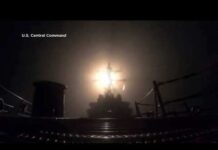
The latest round of U.S. strikes came after three commercial vessels were hit in the Strait of Hormuz, a narrow waterway that carries a huge share of world energy traffic.
U.S. Central Command said the action was meant to punish attacks on innocent civilian shipping and called Iran’s behavior a clear violation of the ceasefire. Reuters reported that a second U.S. official also said early signs pointed to Iran firing on the ships.
The reports pointed to a Qatari liquefied natural gas tanker among the damaged ships, and Qatar blamed Iran for the attack. The United States then revoked a license that had allowed Iranian oil sales, adding economic pressure to military pressure.
That pairing matters. It shows the administration did not treat the shipping attacks as a one-off maritime incident. It treated them as part of a wider campaign to choke Iran’s leverage over trade.
Why the Strait Matters So Much
The Strait of Hormuz is not just another sea lane. It is one of the world’s most sensitive choke points, and even a few attacks can rattle shipping insurance, oil prices, and military planning.
CNBC said the strikes hit more than 80 targets, including anti-ship missile capabilities and more than 60 Islamic Revolutionary Guard Corps small boats, to reduce Iran’s ability to attack commerce. That helps explain why the crisis keeps spreading beyond one damaged tanker.
President Trump says military strikes against Iran will continue "until I say it's enough."
In an exclusive interview with FOX News chief foreign correspondent @TreyYingst on @SpecialReport, Trump was asked whether his objectives in Iran would require U.S. ground forces.
"The… pic.twitter.com/rlvHFgkvZj
— Fox News (@FoxNews) July 14, 2026
BBC and other outlets describe the situation as a war of blockades, with both sides using force to control movement in and out of Iranian ports. That is the key to understanding the dispute.
Once a shipping lane becomes a weapon, every tanker becomes a possible signal, and every warning sounds like a threat. The result is not simple deterrence. It is a loop of action, response, and escalation that can grow without warning.
Iran’s Counterclaim
Iran did not accept the American version of events. Tehran said it does not recognize the memorandum of understanding with the United States, and its officials argued that the American naval blockade is the real breach.
Iran’s military also said it had closed the strait again because the blockade remained in place. That position gives Tehran a clean political line: the United States, not Iran, is the side breaking the deal.
Trump reviewing plans for devastating attacks against Iran beyond Hormuz strikes
——
US President Donald Trump convened a Situation Room meeting on Tuesday to consider a far broader offensive against Iran, with plans reportedly extending beyond current strikes around the Strait of… pic.twitter.com/8Z0ANeXEet— The Cradle (@TheCradleMedia) July 15, 2026
That argument has one obvious weakness and one obvious strength. The weakness is that Iran has not publicly backed its denial with forensic proof showing it did not strike the ships.
The strength is that the public record still shows a legal fight, not a fully documented courtroom case. Even the reporting that cites Iranian warnings on shipping routes leaves room for argument over what counts as an approved path.
The Hard Part: Proof and Legitimacy
The deeper problem is that both sides are fighting over facts and legitimacy at the same time. U.S. officials say the attacks were Iranian and unlawful. Iran says the blockade is unlawful and that its response is defensive.
NBC and Reuters both noted that the United States saw the attacks as enough reason to tighten pressure, while Iran presented the blockade as coercion meant to force negotiations. That is why the story keeps widening.
For readers looking for the most solid ground, the strongest established fact is simple: ships were hit, the United States responded with strikes, and Iran answered by disputing the legal basis of the blockade.
The least settled issue is attribution at the level of public forensic proof. That gap matters because in maritime crises, the side that controls the story often controls the next move. Right now, neither side has fully won that fight.
Sources:
apnews.com, npr.org, cnn.com, aljazeera.com, youtube.com, cnbc.com