
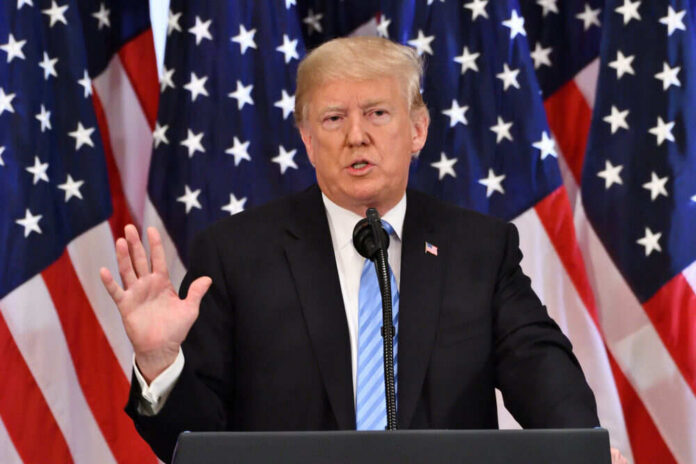
BREAKING UPDATE: TRUMP HAS CANCELED TODAY’S CAMP DAVID MEETING AND WILL HOLD IT AT THE WHITE HOUSE.
When a president convenes his entire Cabinet at Camp David on an unscheduled Wednesday, something serious is either happening or about to happen — and right now, both appear to be true.
Story Snapshot
- President Trump called a rare, unscheduled Cabinet meeting at Camp David amid active nuclear negotiations with Iran.
- Trump publicly described the Iran talks as proceeding “nicely,” but the urgency of the meeting signals far more complexity behind the scenes.
- The session follows U.S. military strikes on Iran that Washington characterized as acts of self-defense, dramatically raising the stakes of any diplomatic resolution.
- Trump’s entire top foreign policy team participated in hours-long strategy discussions covering both the Iran nuclear crisis and the ongoing war in Gaza.
A Venue That Signals Seriousness
Camp David does not get used casually. Since Winston Churchill became the first foreign dignitary hosted there, the presidential retreat has served as the backdrop for decisions that reshape the world. President Carter brokered the Egypt-Israel peace framework there in 1978. Presidents retreat to its pine-covered hills when the weight of a decision demands distance from Washington’s noise. Trump choosing Camp David for a full Cabinet session — unscheduled and mid-week — is a deliberate signal, not a logistical convenience.
President Trump is expected to take the unusual step of holding a Cabinet meeting at Camp David on Wednesday, The Washington Times has confirmed. https://t.co/CDCGgU4fnr
— The Washington Times (@WashTimes) May 26, 2026
Trump convened his entire top foreign policy team for hours of strategy discussions focused on the Iran nuclear crisis and the war in Gaza. That is not a routine briefing. That is a war council. The breadth of participation, the location, and the timing — coming directly after U.S. strikes on Iran that Washington framed as self-defense — all point to an administration managing a situation that is simultaneously dangerous and potentially historic.
Where the Iran Negotiations Actually Stand
The diplomatic backdrop is complicated. Trump set a 60-day deadline for Iran to reach a nuclear agreement. When that deadline passed without a deal, Israel launched strikes against Iran, drawing the United States deeper into the conflict. By late May 2026, reports indicated the two countries were nearing a broader peace agreement following months of conflict and stalled talks.
Trump publicly characterized the negotiations as going “nicely,” though the Camp David meeting suggests his private assessment carries considerably more urgency than that word implies.
The Islamic Revolutionary Guard Corps remnants — Iran’s hardline military force — remain a wildcard. Skeptics watching the negotiations closely have noted that the Guard Corps faction has shown little genuine appetite for a deal, and that Israel’s leadership may be pushing for a more definitive military resolution if diplomacy stalls again. That tension between the diplomatic track and the military reality is precisely the kind of problem that fills hours of Cabinet-level deliberation at a secure presidential retreat.
Reading the Signal Without Overreading the Venue
There is a fair counterpoint worth acknowledging. Camp David’s symbolic weight can cause reporters and observers to project breakthroughs or crises onto meetings that produce neither. The White House has not released a formal agenda or post-meeting readout confirming specific decisions. Historically, the retreat has hosted everything from world-altering summits to quiet weekend strategy sessions that produced nothing publicly notable. The venue alone does not prove a policy pivot occurred.
Trump to convene rare Camp David Cabinet meeting amid rising Iran tensionshttps://t.co/30R04msxcO
— ABC 33/40 News (@abc3340) May 26, 2026
That said, the convergence of factors here is difficult to dismiss as routine. An unscheduled trip, the full foreign policy team, hours of deliberation, active post-strike diplomacy with a nuclear-capable adversary, and an airspace lockdown over the facility — these details collectively argue against treating this as a standard calendar item. Trump’s instinct for leverage and deal-making is well established.
If he believes Iran is close to a framework agreement, he would want his entire team aligned before any final push. That alignment is exactly what a Camp David Cabinet session is designed to produce.
What Comes Next Matters Enormously
The outcome of these Iran negotiations will define a significant chapter of Trump’s second term. A durable nuclear agreement — one with real verification mechanisms and Iranian compliance — would be a foreign policy achievement of the first order.
Failure, on the other hand, with Iran’s nuclear program advancing and the Islamic Revolutionary Guard Corps resisting terms, could force decisions that carry consequences far beyond the Middle East. The Camp David meeting does not resolve that uncertainty, but it confirms the administration is treating it with the gravity it deserves. That, at minimum, is the right instinct.
Sources:
[1] Web – Trump calls rare Camp David Cabinet meeting amid critical Iran talks
[2] Web – 2025–2026 Iran–United States negotiations – Wikipedia
[3] Web – Camp David – The White House
[4] Web – Trump to hold Cabinet meeting at Camp David on Wednesday
[5] Web – Trump discussed Gaza, Iran goals at Camp David strategy session