
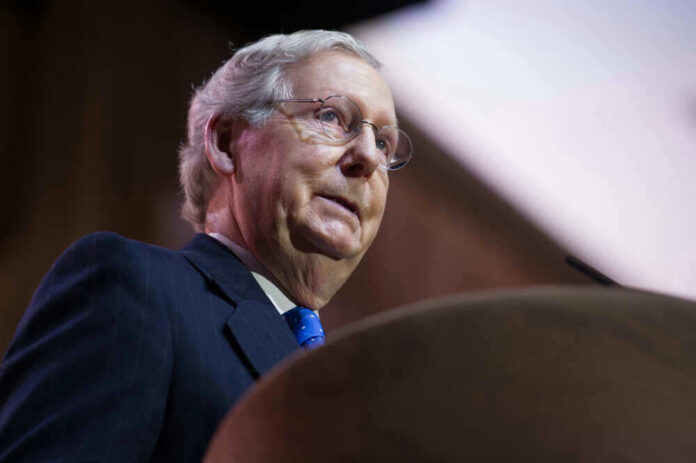
An 84-year-old Senate veteran fell at home, briefly blacked out, and spent a month in the hospital before finally telling the country what happened.
Story Snapshot
- Mitch McConnell says a June 14 fall at his Washington home led to his hospitalization.
- He reports he was briefly unconscious but doctors found no heart attack, stroke, tumors, or brain bleed.
- A mild case of pneumonia during his stay slowed his recovery and kept him off the Senate floor.
- Weeks of silence highlight how little health information powerful politicians are required to share.
McConnell finally explains the fall and hospital stay
Senator Mitch McConnell waited almost four weeks before directly telling voters why he disappeared from public view. In a July message to his Kentucky constituents, he said a fall at his Washington, D.C., home on June 14 left him briefly unconscious and led to his hospital admission.
That simple explanation ends days of rumors that filled the gap left by his office, which offered only vague updates like “receiving excellent care” and “continuing to improve.”
McConnell said his medical team ran “every test imaginable” after the fall. A letter released from the Office of the Attending Physician for Congress backed that up, describing “minor” injuries and listing what doctors did not find: no fractures, no heart attack, no stroke, no tumors, and no hemorrhages.
During the stay, he developed pneumonia, which his doctors said responded quickly to antibiotics, but it added days of weakness and rehab to his recovery.
Weeks of silence and a pattern of cautious disclosure
That clean bill of health on the major conditions is only half the story. The other half is the long silence. For about a month, McConnell’s office refused to say why he was in the hospital, even as reporters pressed for answers and voters wondered if the Senate’s longest-serving Republican was facing a life-threatening crisis.
Statements stayed vague, and the public had to rely on leaked emergency call audio describing an “unconscious” patient and “CPR in progress” at his address.
That tight-lipped approach is not unusual in Washington. American law does not force elected officials to disclose serious medical problems, and privacy rules block doctors from speaking without a patient’s consent.
Scholars who study political health disclosure say that, as a result, the public learns only what leaders choose to share, when they judge it is least politically damaging.
A long record of falls and age-related worries
This latest fall did not come out of nowhere. McConnell is a childhood polio survivor, and he has a long record of falls and injuries in recent years. In 2019, he fractured his shoulder after falling at home.
In 2023, he tripped at a Washington hotel, suffered a concussion and broken ribs, and spent days in the hospital followed by time in a rehab facility. Reporters have documented at least five falls for him between 2019 and 2025.
In a statement posted along with the picture, Mitch McConnell said he was hospitalized due to a fall that left him "briefly unconscious." https://t.co/nOVRhXTXKW
— z1079 (@Z1079) July 14, 2026
Those incidents, plus occasional public “freeze” moments at microphones, feed a broader worry about the age of America’s leaders. Researchers note that today’s Congress is the oldest in modern history, with well over a hundred members aged 70 or older.
Many voters who lean right on policy still ask a basic question: can someone in their mid-80s who has fallen many times and needed weeks of hospital care continue to handle a job that demands sharp focus and long hours? The law does not answer that; only voters do.
Power, privacy, and what voters deserve to know
McConnell’s letter tries to walk a line between honesty and reassurance. He stresses that there was no stroke, no heart attack, no brain bleed, and no sign of a new major disease. That message tells conservatives concerned about stability that the Senate will not suddenly lose one of its most experienced strategists.
At the same time, he admits he hesitated to share details sooner, reinforcing the view that health disclosures from politicians are timed with politics in mind, not public curiosity or full transparency.
Media ethicists warn that the main task for journalists is not to play doctor but to explain how power operates when leaders face health constraints.
For McConnell, the facts point to an 84-year-old man with a history of falls and recent pneumonia who still holds major influence over judges, budgets, and national security.
Sources:
apnews.com, courier-journal.com, facebook.com, theguardian.com, people.com, cnbc.com, youtube.com, instagram.com, ethics.sjmc.wisc.edu, ash.harvard.edu