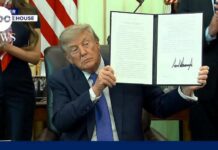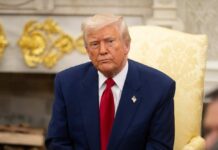
A man hired to quietly scroll President Trump’s words on a screen instead turned those words into a six‑figure betting bonanza.
Story Snapshot
- White House teleprompter operator Gabriel Perez allegedly won over $90,000–$100,000 betting on Trump’s speeches on Kalshi prediction markets.
- Kalshi’s surveillance flagged his trades as suspicious and froze the profits before he could cash out, then alerted regulators.
- The Commodity Futures Trading Commission is investigating possible insider trading, while federal prosecutors passed on criminal charges.
- The case exposes a growing problem: government insiders using special access to game political prediction markets.
The teleprompter guy who turned Trump’s speeches into a side hustle
Gabriel “Gabe” Perez spent years in the shadows, guiding the words President Trump spoke on live television. He was the person behind the teleprompter, making sure every line rolled at the right speed, every phrase appeared at the right moment.
Then investigators say he found another way to use that job. They say he started betting on what Trump would say, using a site called Kalshi, and walked away with close to six figures in profit on those wagers.
President Donald Trump's longtime teleprompter operator, Gabriel Perez, has drawn ire from the White House after reports he'd profited from Kalshi bets linked to content in Trump's speeches. https://t.co/kYWkQSjsD7
— Business Insider (@BusinessInsider) July 16, 2026
Kalshi is a prediction market. It lets people bet real money on questions about politics, economics, and events. One of its most eye‑catching products is “mention markets.” These markets pay out if a public figure uses certain words or phrases in a speech.
According to reports, Perez bet on more than a dozen Trump speeches over several months, including the State of the Union address, and made money when Trump uttered the exact phrases tied to his wagers.
How Kalshi says it caught the alleged insider trading
Kalshi did not stumble onto this by accident. The company runs a surveillance system that looks for unusual trading patterns. In Perez’s case, their head of enforcement said the team “promptly flagged and referred these trades” to regulators after an internal probe.
One source told CNN that Perez’s trades generated more than $90,000 in profits before Kalshi froze the account so he could not withdraw the money. Other outlets put the total closer to $100,000, but all agree the profits were substantial.
The trades stood out because of their timing and accuracy. As Trump’s longtime teleprompter operator, Perez had advance access to speech scripts and likely saw revisions before they went public.
On a platform where people guess which exact words a president will say, knowing the script is a huge edge. That is why Kalshi treated his pattern as potential insider trading and turned the data over to the Commodity Futures Trading Commission, the agency that oversees these markets.
What regulators and the White House did next
Once Kalshi reported the case, the Commodity Futures Trading Commission opened an investigation into whether Perez used nonpublic information from Trump’s speeches to make those bets.
Reports say Perez is cooperating with regulators and entered talks to settle the case. The possible deal on the table would have him give back the profits and accept a ban on placing similar trades in the future, without a full courtroom fight over insider trading.
Federal prosecutors in Manhattan decided not to pursue criminal charges. That choice does not clear Perez but signals they did not think the evidence met their threshold for a criminal case.
The White House placed Perez on unpaid leave and later said he would not return to his job. Trump’s press secretary called the situation “deeply unfortunate” and “a disgrace,” a strong rebuke that lines up with the basic belief that public servants should not cash in on inside knowledge.
The bigger problem: insiders gaming prediction markets
Perez’s case is not happening in a vacuum. Regulators and journalists have documented several recent examples of people with government or campaign access using prediction markets to make large profits.
One Justice Department indictment described a United States Army soldier who used classified military information to bet on Polymarket, turning about $33,000 in wagers into roughly $400,000 when a secret raid took place. These trades look more like high‑tech gambling with insider tips than honest market activity.
The White House already warned staff in April not to use confidential information when trading on prediction markets, after suspicious activity around war decisions and oil prices. More than 40 Democratic lawmakers have pressed for training and new rules across government to keep employees from using private data for bets.
New York’s governor even banned state workers from using any nonpublic information on these platforms. The message is simple: if you work for the public, you do not get to secretly profit from what the public does not know yet.
Why this case hits a nerve on fairness and trust
At its core, the Perez story is about fairness. Regular citizens listen to a speech and maybe argue about it over dinner. A teleprompter operator, if the allegations are right, watched that same speech knowing he had already turned the words into money on a betting site.
That breaks the basic idea that rules should apply the same to insiders and outsiders, and that government work is a duty, not a private jackpot.
Kalshi’s actions matter here too. The company not only caught the trades but froze the profits and turned the file over to regulators. That is the kind of self‑policing many prefer over constant new laws: private firms enforcing clear standards and kicking out cheaters.
Yet as more cases surface, from campaign staff using internal polls to soldiers using classified plans, there is a hard question hanging in the air. Can prediction markets survive in a world where the best way to win is to work in the government and bet on what you know but the public does not?
Sources:
cbsnews.com, reuters.com, gate.com, facebook.com, news.bitcoin.com, pillsburylaw.com, nytimes.com, cnn.com, kslaw.com