
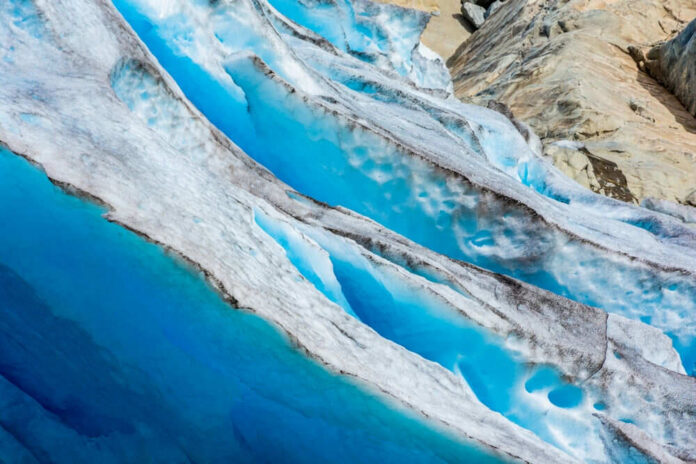
Swiss glaciers lost about one-tenth of their total ice in just two years, a shock confirmed by Switzerland’s own long-running glacier monitors.
Story Snapshot
- Official Swiss data show ice volume fell roughly 10% across 2022–2023.
- Scientists measured mass balance on about 20 glaciers and tracked 95 glacier fronts.
- The 2023 melt ranked second-worst on record, after 2022.
- This collapse is part of a 140-year Swiss record, not a one-off blip.
What the monitors measured, and why it matters
Glacier Monitoring Switzerland reported a national ice loss of about 6% in 2022 and another 4% in 2023, for a near-10 % two-year hit. That figure comes from a system that measures annual mass balance on roughly 20 benchmark glaciers spread across the Alps. The same network checks where hundreds of glacier tongues moved each year, building a map of retreat. A drop this steep squeezes summer water supplies, muddies hydropower plans, and raises rockfall risk as ice support vanishes.
Scientists did not call this a surprise. They flagged a setup that often drives extreme melt: low winter snow, then very warm summer months. Snow shields the surface and reflects sunlight. When snow runs thin, bare ice absorbs heat and melts faster. The 2023 melt rate came in second only to 2022 since consistent records began. That one-two punch turned a long, steady decline into a sharp drop now visible even to casual hikers.
Inside the Swiss data backbone
Switzerland runs one of the world’s deepest glacier records. It measures how much ice each glacier gains in winter and loses in summer, then tallies the annual net. The program’s modern mass-balance core covers about 20 glaciers, which is enough to track national change when combined with length and area surveys. In 2023, scientists also measured terminus positions for 95 glaciers, which helps confirm where ice fronts shrank and by how much across regions. These are not ad hoc snapshots; they are a system.
That system extends back to the 19th century for length change and now includes digital inventories built from aerial images and mapped outlines. The long view matters. A single hot summer can push headlines, but the century-scale record shows a trend of loss, with dramatic years stacked on top of one another. Today’s drop slots into that line. The effect is cumulative: once a glacier thins past a ridge or breaks into pieces, recovery becomes far harder even if a few cool summers return.
How this “disastrous year” fits the bigger pattern
The current results match a well-known pattern in mountain regions. Large melt years often follow winters with weak snow and summers with strong heat waves. Dust on snow can add to the problem by darkening the surface. Scientists across Swiss institutes have framed their work as long-term observation, not a hunt for one-season drama. That is why they maintain many sites and cross-check mass, length, and area change before they call a national number.
Swiss glaciers lost 5.5% of their ice volume in 2026, bringing the total loss to nearly 20% since 2021. Scientists attribute the rapid melting to record summer heatwaves and unusually low winter snowfall pic.twitter.com/6FkZx40BQG
— TSN NEWS (@TSNGlobalNews1) October 2, 2026
Policy talk will focus on water, power, and safety. Alpine communities plan for summer streamflow fed by melt. As glaciers thin, late-summer water drops, and water rights get tighter. Hydropower depends on that timing. Public safety teams face more rockfalls and outburst floods from new lakes at retreating ice fronts. Conservative common sense says prepare early, keep clear records, and act on what repeated measurements show. The Swiss data meet that bar. They show fast loss that demands practical planning now.
Sources:
bbc.com, cryosphere.scnat.ch, doi.glamos.ch, geo.uzh.ch, telegraphherald.com