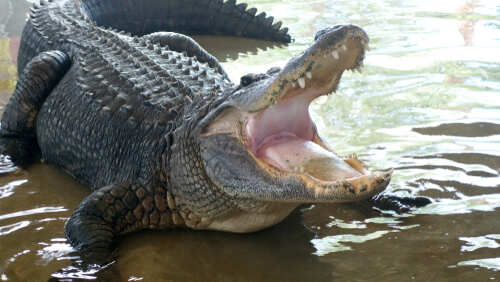
After four years of close calls and sleepless nights, “Snaggletooth” finally surfaced—and the 844-pound giant did not leave Lake Moultrie alive.
Story Snapshot
- Guides captured an 844-pound, nearly 14-foot alligator on Sept. 28 at Lake Moultrie.
- The gator, nicknamed Snaggletooth, ranks as South Carolina’s second-largest confirmed harvest.
- Renegade Bowfishing’s Cole Poplin and William Ard led the hunt with tag holder Chris Webb.
- South Carolina’s rules require harvest reporting within 24 hours and prompt paperwork.
A four-year chase ends in a single night
Renegade Bowfishing guides Cole Poplin and William Ard spent years tracking a massive Lake Moultrie alligator with a jagged grin and a habit of vanishing at the last second. On Sept. 28, at about 11 p.m., they hooked the legend at last. The crew, joined by tag holder Chris Webb and his father, Craig, secured the reptile after a tense fight on the dark water. The scale settled at 844 pounds and the tape read nearly 14 feet, ending a long pursuit.
Multiple outlets confirmed the location, team, and weight, and placed the catch as the state’s second-largest confirmed harvest. The nickname “Snaggletooth” came from the animal’s uneven teeth. The encounter unfolded in Berkeley County’s Lake Moultrie, just north of Charleston, a known habitat for large alligators. Poplin and Ard run hunts on these waters and had tracked this particular reptile across seasons, tides, and moon phases before the opening they needed finally appeared.
What “second-largest” really means in South Carolina
South Carolina keeps score on big gators because its program is formal and strict. The Department of Natural Resources runs a lottery for public tags, enforces size and method rules, and requires documented reporting to validate a harvest. That paper trail is how “second-largest” becomes more than a campfire boast. The agency requires hunters to file an online harvest report within 24 hours and mail any required forms within five business days to keep records clean and comparable year to year.
Those records tell a simple story: healthy alligator numbers and a steady, regulated harvest. The Department’s annual reports show hundreds of animals taken statewide each season, with year-to-year totals that bounce within a normal range. The harvest is recreational by design, with strict tagging and hide validation that track outcomes. That structure lets the state safely celebrate a monster catch while watching long-term population trends with clear eyes and open books.
Why the big ones still matter
Giant gators are rare because time makes giants. Only a small slice of the population reaches 12 feet or more. That is why stories like Snaggletooth travel fast and stick. Big numbers move people. The attention also highlights the value of rules that keep sensational moments grounded in data. The regulated process—tag in hand, legal methods, on-time reporting—protects the resource and the reputation of the hunt. That balance matches common sense and respects the wild animal behind the headline.
GIANT GATOR: 844-Pound Alligator Dubbed “Snaggletooth” Captured In South Carolina
Cole Poplin With Renegade Bowfishing LLC Joined F&F First This Morning To Tell Us How He Caught “Snaggletooth” pic.twitter.com/S690HC4Eza— Fox & Friends First (@FoxFriendsFirst) October 6, 2026
Critics sometimes worry that chasing trophies hurts size classes over time. State data show the program monitors lengths and weights and adjusts as needed. The proper test is not social buzz but the health of the herd over seasons. On that score, the expert view is clear: stick to science, follow the reporting rules, and keep enforcement sharp. When those boxes are checked, one enormous gator does not tip the system. It proves the system works when hunters do their part.
Sources:
wjcl.com, people.com, postandcourier.com, dnr.sc.gov, iucncsg.org, thestate.com