
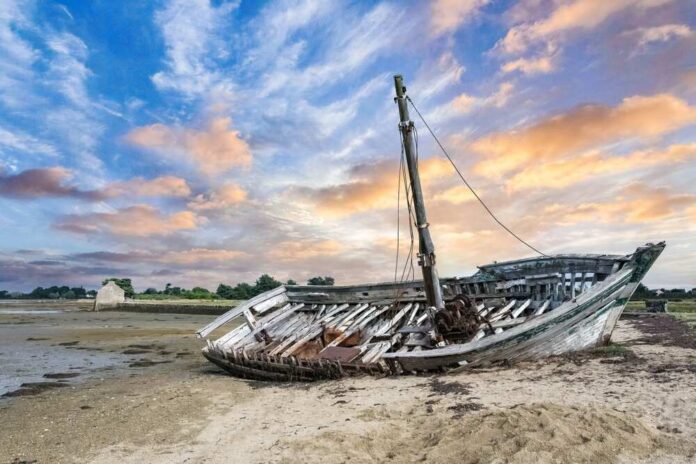
A fierce nor’easter peeled back Nantucket’s south shore and revealed heavy wooden ribs that experts say most likely belong to an 1884 shipwreck tied to a Boston-bound cotton schooner.
Story Snapshot
- Storm surf exposed a large hull fragment near Miacomet Beach on Nantucket’s south shore.
- State maritime archaeologists previously judged this site most likely the Warren Sawyer, wrecked on December 22, 1884.
- Fastenings, wood types, and location align with earlier documentation from 2022 and 2023.
- The Warren Sawyer sailed from New Orleans to Boston with cotton and scrap iron when it ran aground.
The wreck reappears where the record already points
Waves cut a fresh window into the beach near Miacomet and exposed a timbered section that locals quickly filmed and photographed.
David Robinson, director and chief archaeologist for the Massachusetts Board of Underwater Archaeological Resources, reviewed the new visuals and said the exposure sits in the same place as the 2022 material and aligns with the prior identification work. That earlier fieldwork concluded the remains were most likely from the Warren Sawyer, a 19th-century coastal schooner lost just offshore.
The state team’s reasoning leans on concrete traits you can see and measure: the style of fastenings, the timber and plank types, and the layout of framing members. Location matters as well.
The exposed section lies within the same mapped stretch examined in 2022 and 2023, creating a chain of evidence across storms and seasons. The Nantucket Current captured clear images that Robinson used to compare those features against the 2022 documentation.
A doomed run with cotton and iron to Boston
Historical accounts anchor the Warren Sawyer to time and place. Reports state the schooner grounded near Miacomet Beach on December 22, 1884, while sailing from New Orleans to Boston with 1,115 bales of cotton and 28 tons of scrap iron.
That cargo and route match what researchers expect from a coastal trading schooner of that era and square with the site’s position on Nantucket’s exposed south shore.
Storm-driven exposure explains why this story keeps returning. Coastal erosion and nor’easters often reveal buried wrecks for a short window, then sand swallows them again. Archaeologists race the tide to document what they can before the site shifts.
That pattern held here in 2022 and early 2023, when teams mapped a roughly lower-bow hull section and judged it a likely Warren Sawyer fragment. The latest reveal appears to continue that same line of evidence.
What supports the match, and the prudent caveat
Physical markers back the link to the Warren Sawyer. Robinson cited the fastenings, wood choices, framing and planking methods, and the exact position on the beach as consistent with earlier survey and archival research pointing to the 1884 loss. Local reporting notes that the new photos and video align with those earlier notes, strengthening continuity across events.
One brief caution remains: officials say the exposed timbers have not been identified with absolute certainty, a normal stance until full documentation is complete.
Fragments of 19 century shipwreck washes ashore on Nantucket as nor’easter slams the East Coast
The Warren Sawyer, built in 1869, was carrying 1,115 bales of cotton and 28 tons of scrap iron from New Orleans toward Boston when severe weather pushed it off course…
— Defiant L’s (@DefiantLs) September 29, 2026
Context helps explain that caution. Maritime sites change fast under wave energy. Fragments can separate, rotate, and re-bury. Many vessels from the period shared similar construction habits, which is why teams weigh a cluster of signals—cargo history, route, wood species, fastening types, and precise location—rather than hunt for a single nameplate. In this case, the cluster points to the Warren Sawyer, and it does so in the very place prior work already flagged as most likely.
Sources:
cbsnews.com, npr.org, nantucketcurrent.com, nbcnews.com, abcnews.com