
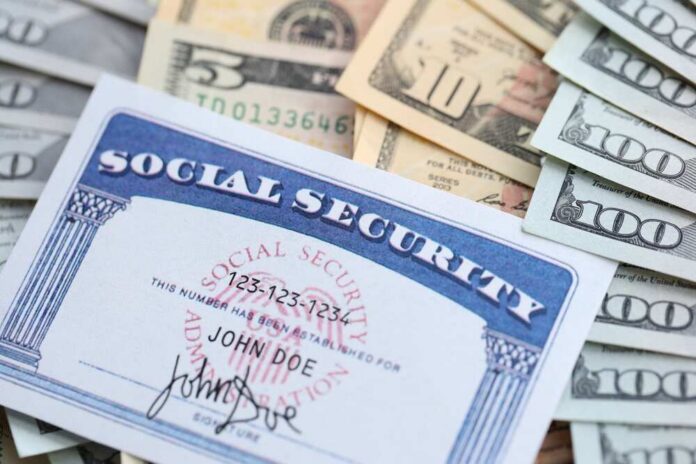
Your Social Security check is now on a seven‑year fuse, and Washington is still arguing over who lit it.
Story Snapshot
- Social Security’s main retirement trust fund is now projected to hit insolvency in 2032, not 2033.[1][2]
- Under current law, that triggers an automatic benefit cut of roughly 22% to 24% for everyone.[1][2][3]
- Analysts warn this means an average hit of about $500 a month in today’s dollars for retirees.[1][3][5]
- Congress can still fix it, but every year of delay makes the cure sharper and more painful.[2][3][4]
The New 2032 Insolvency Date And What It Really Means
Social Security’s own trustees now say the Old-Age and Survivors Insurance trust fund, the piece that pays retirement and survivors benefits, will run out of reserves in late 2032 instead of 2033.[1][2]
When that happens, the system does not go to zero. Payroll taxes will still come in every paycheck. But under current law, the program can only pay out what it collects. That math supports roughly 78% of promised benefits, which means about a 22% cut.[1]
The trust fund Social Security relies on to help pay retirement benefits may run out in 2032, at which point 78% of benefits will be payable, according to the Social Security Administration’s annual trustees report released on Tuesday.
That projected depletion date is three… pic.twitter.com/NGcz2bvqzb
— CNBC (@CNBC) June 9, 2026
Other analysts looking at the same basic numbers see similar or even bigger cuts. The Committee for a Responsible Federal Budget estimates an across-the-board cut closer to 24% once the retirement trust fund is empty.[2][3]
The Congressional Budget Office projects that under its baseline, trust fund insolvency in 2032 would trigger about a 28% drop in old-age and survivors benefits.[4] The exact number depends on assumptions, but the direction is clear: a large automatic cut if Congress does nothing.
How We Got From 2033 To 2032 So Quickly
The scary part is not just the date; it is how fast it moved. Last year’s trustees report still showed depletion in 2033.[1][2] New estimates now point to the end of 2032, shaving off about a year.[1][2]
Analysts tie part of that shift to recent legislation, including the 2025 Budget Act and the so-called One Big Beautiful Bill Act, which changed how Social Security benefits are taxed and nudged the finances in the wrong direction.[1][2][6] Demographics do the rest: more retirees living longer, fewer workers paying in.
These are not wild guesses from activists. The Committee for a Responsible Federal Budget notes the Chief Actuary of Social Security has confirmed the updated late‑2032 insolvency timing, and even the combined retirement and disability funds are now projected to run dry around 2034.[2]
The Congressional Budget Office’s separate baseline says much the same year for insolvency and warns that the needed benefit cut now looks larger than earlier estimates.[4] When very cautious scorekeepers agree, people should pay attention.
What A 22–28 Percent Cut Looks Like In Real Life
Numbers on a page feel abstract until you see the household impact. CBS News, using the trustees’ 78% figure, reports that the average retiree faces about a $500 per month hit once the trust fund is depleted.[1]
A report summarized by 401k Specialist Magazine finds that in 29 states, typical retirees could lose more than $500 a month if a 24% cut took effect in today’s terms.[3][5] Committee for a Responsible Federal Budget estimates that a typical couple could see an $18,400 drop in yearly benefits after insolvency.[2][3]
Those cuts do not just skim “extra” cash off the top. In many states, between 10% and 23% of the entire population would feel the hit, because Social Security is a main income source, not a bonus.[3][5]
For some low and middle-income retirees, this is the mortgage payment, the prescription budget, or the grocery money. From a common-sense view, pushing people who played by the rules into deeper dependence on other welfare programs by ignoring the math is both unfair and fiscally reckless.
Why “Insolvent” Does Not Mean “Nothing To Worry About”
Some voices try to ease the sting by saying “Social Security is not going broke” because checks will not stop, only shrink. That line is technically true but deeply misleading.
The trustees, the Congressional Budget Office, and watchdog groups all agree that when the trust fund is empty, current law forces a sudden across-the-board cut to match benefits with incoming taxes.[1][2][4] That is not a gentle trim; it is a cliff, with no protection for today’s 50‑ and 60‑somethings.
Conservatives tend to see this as a trust issue as much as a math issue. Workers were told for decades that these benefits were “earned.” Now the official scorekeepers warn the government will only be able to keep about three-quarters of that promise unless lawmakers act.[1][2][4]
Kicking this can further down the road invites deeper cuts, higher taxes on younger workers, or both. The real choice is not between change and no change. It is between smaller changes now or a brutal automatic cut later.
Sources:
[1] Web – Social Security insolvency now projected for 2032, putting benefits at …
[2] Web – Social Security insolvency now projected for 2032, putting benefits at …
[3] Web – 2026 Social Security Trustees Report Moves Insolvency to 2032
[4] Web – Americans split on how to save Social Security from insolvency as 2032 …
[5] Web – Trustees Warn Social Security and Medicare Are Approaching Insolvency
[6] Web – 2026 Social Security Trustees Report, Explained