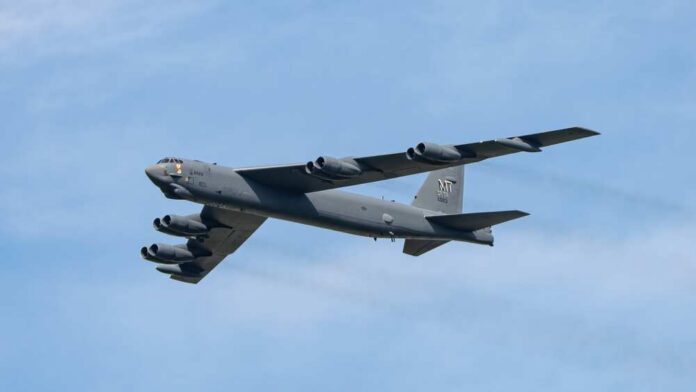
The most advanced bomber on the planet lifted off into the clear desert sky—and was gone in seconds.
Story Snapshot
- Eight people died when a B-52 Stratofortress crashed just after takeoff from Edwards Air Force Base during a radar test mission.
- Officials say the cause is unknown and under investigation, even as footage shows a catastrophic, unsurvivable impact and fireball.
- The flight mixed active-duty aircrew, government civilians, and Boeing employees, raising heavy questions about risk and accountability.
- This was the deadliest B-52 loss in decades, part of a long, often hidden history of bomber crashes and hard lessons paid in blood.
A routine test flight that turned into eight folded flags
The mission looked routine on paper: a B-52 Stratofortress, eight souls on board, rolling down a long Edwards Air Force Base runway for a radar modernization test around 11:20 a.m. local time.
The jet never made it to altitude. Officials say it crashed shortly after takeoff on or near the airfield and that the wreck was “not survivable.” When they reviewed the crash footage, commanders called it “unrecoverable” and confirmed all eight on board were gone.[2]
UPDATE: 8 crew members killed in B-52 crash at Edwards Air Force Base in California pic.twitter.com/xgOdSwA70n
— BNO News (@BNONews) June 15, 2026
This was not a ferry hop with an empty cabin. The crew combined uniformed military aviators, government civilians, and contractors.[1] Boeing later confirmed that two of its employees were on the aircraft.[1] That mix matters.
It means not only the United States Air Force, but also the defense industry and federal civil workforce had people in harm’s way on this flight. When a test jet goes down in that setting, the questions reach far beyond one squadron or one base.
What we actually know – and what we absolutely do not
Air Force leaders have been blunt on one point and careful on another. They are certain about what happened: the bomber crashed moments after takeoff, the impact and fireball left no chance of survival, and emergency crews shifted quickly from rescue to recovery.
They are cautious about why it happened. The deputy commander at Edwards told reporters, “We don’t have any indication as to what the cause was,” and stressed that the crash is under active investigation.[1]
That uncertainty is not a dodge; it is standard crash protocol. A bomber that big hitting the ground at speed leaves a wide debris field, intense fire damage, and shredded systems. Investigators now have to gather flight data recorders, radar tapes, tower communications, maintenance logs, and video before they can say whether this was engine failure, control loss, structural break, human error, or some ugly chain of small problems. From past B-52 mishaps, the full story often takes months.[5]
A deadly chapter in a long, hard history of bomber risk
This is not the first B-52 to die at low altitude, and it will not be the last written about in accident summaries. A public list of B-52 incidents shows decades of crashes from trim mistakes, low-altitude turns, structural overload, aborted takeoffs, and fire.[5]
Some killed nearly entire crews. Others ended with everyone ejecting and walking away. CNN notes this Edwards disaster is the deadliest B-52 loss since 1982, when nine airmen died near Sacramento on a training flight.[5]
8 people died in B-52 bomber crash at US Air Force base in Southern California, officials say. https://t.co/T9N1U7dGoA
— ELLIOT IN THE MORNING (@EITMonline) June 16, 2026
That history supports a sober view: high-risk military testing will never be perfectly safe, but the country owes its people transparent answers and real fixes when something preventable kills them.
Past investigations have forced changes in low-level flight rules, training standards, and test planning. When the facts pointed to reckless flying or poor oversight, commanders lost their jobs, and procedures changed. That is how a serious nation should respond to deadly failure.
Why this one hits a nerve beyond the base fence
Several details push this crash out of the usual “tragic training accident” box. First, the mission was part of a radar modernization program, not simple pattern work.[1][2] A test profile often means nonstandard configurations, extra gear, and dense checklists.
Second, the presence of Boeing employees on board links the contractor directly to the risk, not just to the hardware back at the factory.[1] That raises fair questions about who signed off on this test plan and who accepted which risks.
Third, the crash happened on home soil, in daylight, with cameras rolling. Social media filled with clips of black smoke over the Mojave and captions blaming everyone from the president to “government incompetence.” Much of that is knee-jerk noise.
But beneath the noise sits a real concern: Americans see hundreds of billions going to defense each year, yet they still watch high-profile crashes with “cause unknown” headlines. Common sense says that kind of disconnect eats away at public trust.
What accountability should look like now
The right response is neither blind faith in official statements nor wild conspiracy hunting. It is hard-nosed patience. The United States Air Force safety and accident boards must secure every scrap of evidence, reconstruct the flight, and publish every detail that can be safely shared without exposing warfighting secrets.
Congress should press for answers on maintenance history, test approvals, and whether any waivers or shortcuts touched this mission. That is not anti-military; it is pro-American.
For families, eight flag-draped coffins will soon move under quiet salutes. For the country, the real honor comes later, when the investigation is done and changes follow. Maybe it will be a new limit on test profiles near the runway, a hardware fix, or a change in how mixed crews of military and contractors run complex missions.
Whatever the findings, one standard should guide the final report: those eight people were “great Americans,” as their commander said—and great Americans deserve more than a shrug and a press release.[1]
Sources:
[1] Web – 8 people died in B-52 bomber crash at US Air Force base in Southern …
[2] Web – 8 people killed in B-52 bomber crash during ‘routine test mission …
[5] Web – US Air Force B-52 crashes in California | Investigation – Al Jazeera