
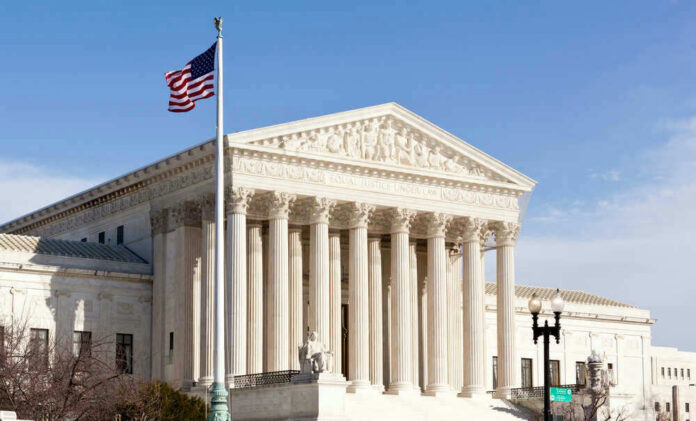
The Supreme Court just stripped away a 91-year-old legal shield that let unelected bureaucrats run federal agencies without answering to the President — and the ruling reshapes how Washington works.
Story Highlights
- The Supreme Court ruled 6-3 that the President can fire Federal Trade Commission (FTC) commissioners at will, overturning a 1935 precedent called Humphrey’s Executor v. United States.
- Chief Justice John Roberts wrote that agency officials who exercise executive power must be accountable to the President — and that means removable by him.
- The ruling came after President Trump fired two Democratic FTC commissioners in 2025, citing policy disagreements.
- The decision could affect other independent agencies, such as the Equal Employment Opportunity Commission (EEOC) and the National Labor Relations Board (NLRB), but the Federal Reserve appears to be protected for now.
What the Court Decided
On June 29, 2026, the Supreme Court ruled 6-3 in Trump v. Slaughter that the FTC’s for-cause removal protections are unconstitutional. The majority held that the FTC “unquestionably exercises executive power” by filing lawsuits, writing rules, and deciding cases.
Because those are executive functions, the President must be able to fire commissioners at will. The Court said Congress cannot block that authority.
Chief Justice Roberts wrote plainly: “What text, history, and structure settle, our precedent confirms — the President may remove his subordinates at will.”
He added that subordinates who exercise the President’s power must remain accountable to him, and through him, to the American people. The ruling also said that “quasi-legislative” and “quasi-judicial” labels long used to describe the FTC were always a legal fiction.
How This Case Started
The case began when President Trump fired FTC commissioners Rebecca Slaughter and Alvaro Bedoya in early 2025. Both were Democrats. Trump cited policy disagreements — not the legal standards of inefficiency, neglect, or misconduct required by the FTC Act.
The fired commissioners sued, arguing the law protected them. Lower courts initially sided with them, but the Supreme Court reversed the decision and upheld the firings.
6 conservative Supreme Court Justices have increased Trump's power over independent federal agencies.
This ruling allows Trump to fire Democratic appointee and former FTC Commissioner Rebecca Slaughter. pic.twitter.com/CDu1FKfuEg
— Headquarters (@HQNewsNow) June 29, 2026
The case directly challenged Humphrey’s Executor, a unanimous 1935 ruling that let Congress protect independent agency heads from removal without cause. That precedent had stood for 91 years. The new majority said the 1935 decision was built on an outdated and narrow view of what the FTC actually does. Today’s FTC is far more powerful than the one the 1935 Court described.
What This Means Going Forward
The ruling has wide reach beyond just the FTC. Legal experts say it could apply to other multi-member independent agencies that exercise executive power, including the EEOC and the NLRB. However, the Court carved out one notable exception.
In a companion case, Trump v. Cook, the justices indicated that the Federal Reserve Board of Governors holds a special historical status that may shield it from the same rule.
Importantly, the ruling does not eliminate any agency’s legal authority. The laws those agencies enforce stay on the books. Their power to regulate, investigate, and enforce remains intact.
What changes is who controls the people running those agencies. Justice Neil Gorsuch wrote separately to note the decision does not kill agency rulemaking power — it simply moves that power back under the President’s roof.
The Dissent and the Pushback
Justice Sonia Sotomayor, joined by Justices Elena Kagan and Ketanji Brown Jackson, called the decision “grievously wrong.” The dissent argued that the Constitution’s text, history, and long-standing practice all support Congress’s ability to protect independent agency heads from removal.
The three liberal justices warned the ruling hands the President “far greater power than ever before.” Former commissioners Slaughter and Bedoya also publicly criticized the decision after it came down.
For conservatives, the frustration with unaccountable bureaucrats has been real and long-standing. Agencies have pushed policies for years with no clear line back to elected officials.
This ruling fixes that. It restores a basic principle: if an agency wields executive power, the executive must control it. The President is elected. Commissioners are not. Accountability has to flow somewhere — and the Court just made sure it flows to the person voters chose.
Sources:
wiley.law, abcnews.com, appellate.net, npr.org, yalejreg.com, sidley.com