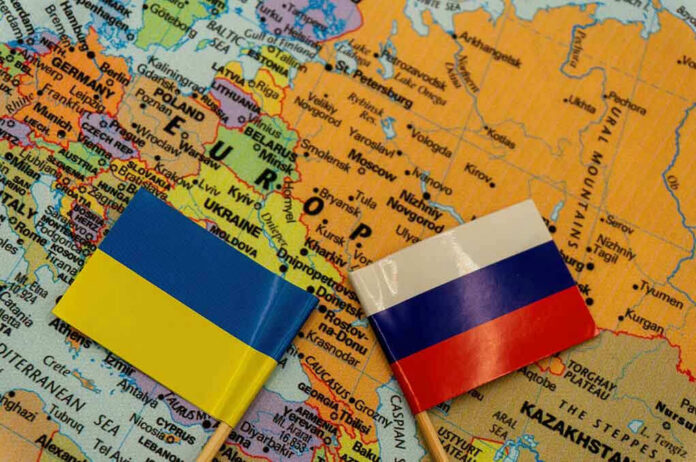
Four years after Russia’s full-scale invasion, Ukraine remains locked in Europe’s bloodiest conflict since World War II, with 55,000 Ukrainian troops dead, 20 percent of the nation occupied, and American taxpayers footing billions in aid while peace talks stall and Putin vows to continue the fight.
Story Snapshot
- February 24, 2026, marks four years since Russia’s invasion of Ukraine, which began in 2022
- Russia occupies approximately 20 percent of Ukrainian territory despite sustained resistance
- Ukraine has lost 55,000 troops, while civilian casualties mount from ongoing drone attacks
- Recent US-brokered peace talks concluded on February 18, 2026, in Geneva with no clear breakthrough
- Drone warfare has become the conflict’s defining feature, reshaping modern military tactics
Four Years of Costly Stalemate
Russia launched its full-scale invasion on February 24, 2022, after months of military buildup along Ukraine’s borders. Putin justified the attack as a “special military operation” aimed at “demilitarization” and “denazification” of Ukraine, language that struck Americans as Orwellian propaganda masking territorial ambition.
The invasion followed years of Russian aggression, including the 2014 seizure of Crimea and proxy warfare in eastern Ukraine that killed over 14,000 people. Four years later, the war continues with no end in sight, despite recent diplomatic efforts.
The human cost has been staggering, with President Zelenskyy confirming 55,000 Ukrainian military deaths as of February 4, 2026. This represents an immense sacrifice for a nation fighting to preserve its sovereignty against a numerically superior aggressor.
American Involvement and Peace Negotiations
The United States has served as Ukraine’s primary military and financial backer throughout the conflict, providing billions in aid that American taxpayers have shouldered during a period of domestic economic challenges. The Trump administration brokered the third round of trilateral peace talks between Ukraine and Russia, which concluded in Geneva on February 18, 2026.
While specific outcomes remain undisclosed, the negotiations represent a potential shift toward diplomatic resolution after years of military deadlock. Critics within conservative circles have questioned the open-ended commitment of American resources to a European conflict, arguing that European NATO members should bear greater responsibility for continental security.
The negotiations reflect President Trump’s stated commitment to ending the conflict, though the complexity of territorial disputes and security guarantees presents formidable obstacles.
To mark 4 years of Ukraine’s resistance to russia’s full-scale invasion, iconic landmarks across the world once again shone in blue and yellow🇺🇦
Thank you for these beautiful gestures of solidarity and support💙💛 pic.twitter.com/xrg0YQTvj3
— UNITED24 (@U24_gov_ua) February 24, 2026
Drone Warfare Reshapes Modern Combat
The conflict has become defined by drone warfare, with cheap, disposable unmanned systems transforming battlefield tactics. Russia established dedicated Unmanned Systems Forces in November 2025, institutionalizing this technological shift.
Recent attacks demonstrate drones’ devastating effectiveness: a Russian drone struck a minibus carrying Ukrainian mineworkers on February 1, killing twelve and injuring sixteen civilians. Ukrainian forces responded with drone strikes against Russian infrastructure, hitting the Neftegorsk Gas Processing Plant in Samara Oblast on February 21 and destroying Russian naval assets in Crimea.
SpaceX temporarily shut down Starlink satellite internet terminals across Ukraine on February 1 after evidence emerged that Russian forces were exploiting the service for military operations. This technological evolution has implications far beyond Ukraine, signaling how future conflicts may be fought with relatively inexpensive unmanned systems.
Territorial and Geopolitical Consequences
Russia currently occupies roughly 20 percent of Ukrainian territory, including four regions Putin formally annexed in September 2022: Donetsk, Luhansk, Zaporizhzhia, and Kherson.
These illegal annexations violate international law and established post-World War II norms against territorial conquest. Ukraine launched a significant counteroffensive into Russia’s Kursk region on August 6, 2024, demonstrating continued military capability despite resource constraints.
The conflict has fundamentally reshaped European security, prompting Finland and Sweden to abandon decades of neutrality and seek NATO membership in May 2022. For conservatives who value national sovereignty and oppose globalist entanglements, the war presents a complex dilemma: supporting a nation defending its borders against aggression while questioning the scope and duration of American financial commitments abroad.
The war has inflicted immense humanitarian costs, with millions of Ukrainians displaced and civilian infrastructure systematically targeted. On February 22, explosions in Lviv’s historic Old Town killed a police officer and injured 25 others in an attack Ukrainian security services attributed to Russian operatives.
The destruction of cultural heritage sites, energy facilities, and civilian areas reflects a brutal campaign that disregards international humanitarian law. The conflict has also disrupted global food security, as Ukrainian grain exports remain constrained, and European energy markets continue facing volatility from Russia’s weaponization of energy supplies.
As the war enters its fifth year, the path toward resolution remains uncertain, with territorial disputes, security guarantees, and NATO membership questions presenting formidable obstacles to any negotiated settlement that respects Ukrainian sovereignty.
Sources:
Timeline: 4 years of Russia-Ukraine war, key turning points – Anadolu Agency
Timeline of the Russo-Ukrainian war (2022–present) – Wikipedia
2022 Russian invasion of Ukraine – Britannica
Ukraine Timeline – Cairn University LibGuides
Timeline of the Russo-Ukrainian war (1 January 2026 – present) – Wikipedia
Conflict in Ukraine – Council on Foreign Relations Global Conflict Tracker