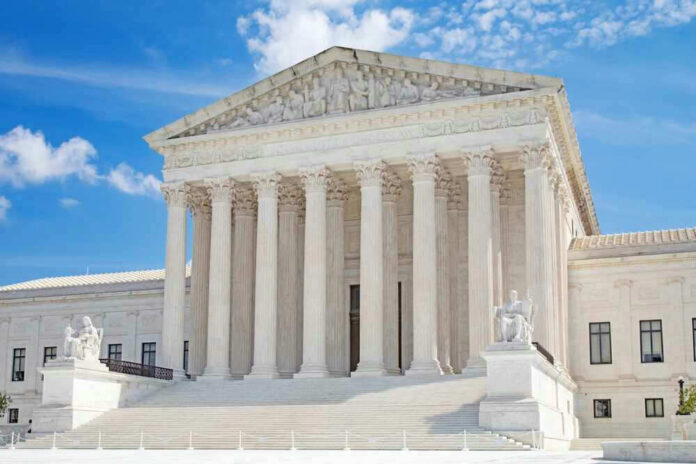
The Supreme Court shut the door—twice—on efforts to erase a $5 million civil judgment against President Trump in E. Jean Carroll’s case.
Story Snapshot
- A New York jury in 2023 found Trump liable for sexual abuse and defamation, awarding $5 million.
- The Supreme Court declined review in June 2026, leaving the verdict intact.
- A follow-up request to reconsider was also denied without comment.
- The Second Circuit had already upheld the verdict and the trial judge’s evidence rulings.
What the Jury Decided and Why It Stuck
A Manhattan jury found that Trump sexually abused E. Jean Carroll in the mid-1990s and defamed her decades later in a 2022 online post. The jury did not find rape, but it did find sexual abuse and defamation, and set damages at $5 million. The legal path matters here.
Appellate judges review law, not witness credibility. The Second Circuit concluded the trial judge applied the rules correctly and affirmed the judgment in full.
Supreme Court again rebuffs Trump in $5M E. Jean Carroll case https://t.co/8oKlAF3wut pic.twitter.com/hge04FPI1f
— New York Post (@nypost) August 17, 2026
The Supreme Court then took a look at the case and said no to review. That decision came in a short order with no dissents listed. That ended Trump’s attempt to overturn the verdict in that case.
The Court later rejected a request to reconsider, again without a written explanation. That sequence left the jury’s verdict and the appellate court’s affirmance as the final word in the $5 million matter.
How the Appeals Court Saw the Evidence Rules
The defense argued the jury saw evidence that should not have come in and that it colored how jurors viewed Trump. The Second Circuit reviewed those objections and found no reversible error.
The panel upheld the trial judge’s use of federal evidence rules that allow certain prior-acts evidence in sexual-misconduct civil cases, and it left the damages award as set by the jury. That ruling gave the Supreme Court little reason to step in.
This posture fits a common pattern in civil defamation and misconduct cases. Appellate courts rarely disturb fact-bound verdicts unless the trial judge misapplied the law.
Denial of Supreme Court review does not endorse the result; it leaves the lower ruling in place. But the effect is the same for the parties: the judgment stands, and collection issues move to the front of the line.
Trump’s Denials and the Defamation Finding
Trump has denied Carroll’s account for years. He called her claim “a false, disgusting lie” in a recorded deposition, and he posted that she was “not my type.” The jury found that his 2022 post defamed Carroll and awarded damages based on that publication.
The reporting on the trial record shows the jury separated rape from sexual abuse and still found defamation tied to the later statement. The verdict rested on the evidence the court allowed and the jury’s credibility calls.
BREAKING: The U.S. Supreme Court has REJECTED Trump’s renewed request to hear his appeal of the $5 MILLION verdict in favor of E. Jean Carroll.
The nation’s highest court has once again refused to intervene.
Trump loses again. pic.twitter.com/mehd5WzNzK
— Darline Graham Q🇺🇸 (@DarlinGrahamSC) August 18, 2026
Trump responded to the Supreme Court’s refusal to hear the case by blasting the ruling and calling the matter a fake case. That is his view, but it does not change the legal outcome. Courts speak through judgments.
The judgment here survived trial, survived the Second Circuit, and survived two passes at the Supreme Court’s doorstep. That closes this case’s appellate lane while other, separate Carroll litigation follows its own track.
What This Means Going Forward
The $5 million judgment remains enforceable. The ruling does not set national precedent, but it ends this fight for these claims between these parties. This $5 million verdict stems from a 2023 jury finding on sexual abuse and a 2022 defamation post.
The larger $83.3 million defamation judgment concerns earlier 2019 statements and different legal defenses, including presidential-immunity arguments still moving on their own schedule.
Sources:
apnews.com, abcnews.com, theguardian.com, cnbc.com, scotusblog.com, reuters.com