
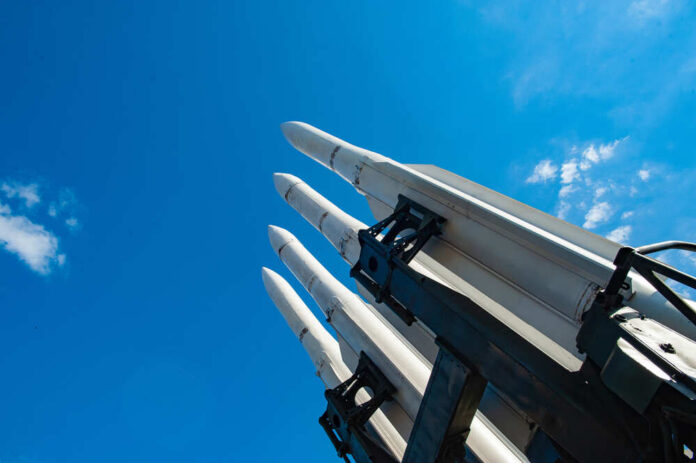
The Iran war did not just test U.S. missiles in combat; it burned through a huge share of America’s most advanced long-range weapons, opening a real “window of vulnerability” that defense planners now have to close.
Story Snapshot
- U.S. forces used at least 45 percent of Precision Strike Missiles during the Iran war, with one official saying the entire inventory was fired.
- Analysts say rebuilding stocks of key long-range missiles and air defense interceptors will take from one to four years.
- Heavy missile use against Iran raised concern about U.S. readiness for a future war with a major power like China.
- Pentagon secrecy over exact stockpile numbers leaves the public debate driven by think tanks, leaks, and expert estimates.
Missiles were the backbone of the Iran campaign
U.S. commanders fought the Iran war by leaning hard on long-range precision missiles and high-end air defense systems.
A major analysis from the Center for Strategic and International Studies, which tracked the first 39 days of strikes, found that American forces focused on seven “exquisite” munitions: Tomahawk land attack missiles, Joint Air-to-Surface Standoff Missiles, Precision Strike Missiles, Standard Missile-3, Standard Missile-6, Terminal High Altitude Area Defense interceptors, and Patriot air defense missiles.
Those weapons did most of the work in the early phase of the war, when the United States hit more than 13,000 targets to smash Iran’s missile and air defense networks.
Long-range missiles reached deep into Iranian territory and struck hardened or heavily defended sites that cheaper, shorter-range bombs could not safely hit. Air defense interceptors shielded U.S. bases and allies from waves of Iranian drones and ballistic missiles that tried to punch back.
U.S. has used 'virtually all' of its long-range precision missiles during Iran war: Reuters https://t.co/Hdd5oEHHXO
— CNBC (@CNBC) August 4, 2026
Precision Strike Missiles were burned at a startling rate
The most striking detail is what happened to the Precision Strike Missile, the U.S. Army’s new ground-launched, long-range precision fire. Before the war, deliveries had only just started, and analysts estimate the Army had received about 90 of these missiles by 2026.
In the Iran campaign, U.S. forces used an estimated 40 to 70 of them, meaning at least 45 percent of the inventory was expended in a single conflict.
One Army official went further and claimed that the “entire inventory of Precision Strike Missiles” was fired during the war. Other officials pushed back and said some remained, but they did not release numbers.
The fact that serious people inside the Army can even argue about whether a brand new strategic missile was completely used up in its first war is a flashing red light. It suggests planners entered the conflict with thin stocks and hoped industry could catch up later.
Air defense stocks dropped deep into the danger zone
The same analysis shows that U.S. air defense interceptors took heavy losses in inventory as they protected forces from Iranian attacks. Patriot missile stocks dropped by about half, while Terminal High Altitude Area Defense interceptors saw use of more than half their pre-war inventory.
These systems are not cheap or easy to replace. Experts say Patriot, Terminal High Altitude Area Defense, and similar interceptors will take three years or more to get back to pre-war levels.
For Americans who care about strong borders and peace through strength, that is the core worry. The United States could still finish the Iran fight, but burning through so many Patriot and Terminal High Altitude Area Defense missiles for one regional war means fewer interceptors on hand if a major power tests U.S. resolve somewhere else. Analysts warn this creates a multi-year “window of vulnerability” while factories try to catch up.
Industry cannot instantly refill the missile magazines
The U.S. defense industry does not turn out these advanced missiles like consumer goods. Each Tomahawk, Joint Air-to-Surface Standoff Missile, or Precision Strike Missile needs complex parts, trained workers, and careful testing.
The CSIS report “Rebuilding U.S. Missile Inventory: A Multiyear Project” concludes that Joint Air-to-Surface Standoff Missiles and Precision Strike Missiles alone will take several months to a year to replace, while systems like Patriot and Terminal High Altitude Area Defense need three or more years.
Unnamed U.S. officials told reporters the industrial base simply cannot produce missiles fast enough to replace what was fired in the Iran war.
That message lines up with years of criticism that Washington spends billions but still ends up with shortfalls in the exact weapons needed most in a crisis. When a war exposes that reality, the answer is not to shrug and hope for peace. It is to demand clear plans, more capacity, and less bureaucratic delay.
Secrecy and media framing shape how the public sees the risk
Munition inventory data is classified. The Pentagon does not publish a simple chart showing how many Precision Strike Missiles, Patriots, or Terminal High Altitude Area Defense interceptors it had before and after the war.
That secrecy protects operational security, but it also means citizens and even many lawmakers rely on think-tank estimates, anonymous leaks, and secondary reporting. CSIS, CNN, Fox News, Al Jazeera, and others all repeat similar depletion figures, which reinforces the narrative even when underlying documents stay hidden.
That reality calls for level-headed judgment. On one hand, this is not social media rumor; CSIS bases its numbers on budget documents, delivery schedules, and close alignment with classified assessments.
On the other hand, conservatives are right to want the hard data that proves whether the United States truly used nearly half of its long-range precision missiles and how fast those stocks will recover. Until Congress forces more transparency, America has to plan as if these warnings are real, because the cost of being wrong would be paid in the next war, not in a spreadsheet.
Sources:
cnbc.com, militarytimes.com, facebook.com, en.yenisafak.com, cnn.com, chosun.com, businessinsider.com, csis.org, militarnyi.com, heritage.org, americanmind.org, cbsnews.com, cronkitenews.azpbs.org, youtube.com, reddit.com