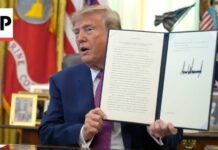
President Trump put a hard number on the table: $5,000 for every American adult, if Republicans control both chambers of Congress.
Story Snapshot
- Trump pledged a $5,000 “Trump dividend” to every adult citizen, tied to GOP wins in the House and Senate.
- He restated the promise days later, saying the country can afford it.
- Major outlets reported the same core pledge in the same news cycle.
- No funding plan or bill text was provided, and cost estimates top $1 trillion.
What Trump Promised And The Exact Conditions
Trump told a packed convention hall in Dallas that every adult U.S. citizen would receive $5,000 if Republicans win the House of Representatives and the United States Senate. He called it the “Trump dividend,” and framed it as a direct cash payout.
The wording left little wiggle room on the condition: both chambers must be Republican-controlled. Major outlets, from wire services to broadcast, captured the same line within hours and into the next day, locking in the on-the-record pledge.
President Trump doubled down on his promise to send $5,000 to every American adult if Republicans retain control of the House and Senate in November, insisting the country can "easily" afford the massive proposal.
"We have trillions of dollars coming into the country, and the… pic.twitter.com/4mKcfAThY9
— FOX Business (@FoxBusiness) September 14, 2026
Trump also added a twist: spend it at home. He said the money should be used inside the United States and quipped about not going to Canada to spend it. That detail roots the idea in a “buy American” frame many voters know.
It also hints at a goal beyond short-term relief: push consumer dollars toward U.S. businesses. The hook is simple, the marketing is sharper, and the audience is everyone with a driver’s license and a tax record.
How Big The Price Tag Really Is
Reporters put fast math to the microphone moment. Estimates ran from about $1.2 trillion to $1.35 trillion, depending on how many adults qualify and when you count them. That scale rivals the largest rescue packages in recent memory.
It also lands against a near $1.8 trillion annual deficit, which would make any new outlay face steep headwinds. No White House budget score, no Congressional Budget Office score, and no Treasury pay-fors surfaced with the pledge.
Trump defended the idea after Dallas. He said the nation is taking in plenty of money and that strong growth makes room for a dividend.
He argued it is a reward for a country that has delivered under his leadership. He also pushed back on the claim that this was only about turnout. He said he did not float the idea to juice the vote, and he stuck with the number when pressed.
The Missing Pieces Between A Pledge And A Check
The pledge did not include draft legislation, an executive authority plan, or an agency pathway to deliver the checks. Congress would need to appropriate funds or pass authorizing law for a nationwide payout at that scale.
That is normal for federal spending of this size, but it means every step runs through committees, floor votes, and the clock. The mechanics—eligibility, tax treatment, fraud control, and speed—remain out of public view for now.
Several outlets also flagged that the cost range varies by adult population counts and timing, which leaves the total not yet fixed in public documents. That does not change the basic fact of the pledge but does affect downstream choices.
Lawmakers would need to decide whether to phase payments, set income caps, or tie the checks to revenues, tariffs, or spending cuts. Each choice makes a different set of winners and losers in budget terms.
What Comes Next If Republicans Win Both Chambers
If Republicans secure both the House and the Senate, the next move would be bill text. Expect a short, simple headline section and many pages of fine print. The fastest path would mirror past direct payments with tax records and the Internal Revenue Service as the engine.
A domestic-spending condition could complicate delivery and oversight unless crafted as a time-limited tax credit for verified U.S. purchases, which is easier to audit than cash with strings.
Three tests matter. First, funding clarity: identify offsets, cuts, or new revenues to avoid adding fuel to inflation and debt. Second, fairness: pay every adult citizen as promised, or if targeted, explain the logic in plain terms.
Third, growth: design it to lift U.S. output, not just demand. If the checks boost Main Street orders, hiring, and investment, the pledge reads as economic policy. Without that, it risks becoming a headline without a balance sheet.
Sources:
apnews.com, usatoday.com, reuters.com, theguardian.com, bbc.com, english.elpais.com, npr.org, foxnews.com, politico.com