A melting glacier in the Swiss Alps just solved a 34-year mystery, handing two Belgian families the answer they waited more than three decades to hear.
Story Snapshot
- A hiker found two bodies on the Trift Glacier in southern Switzerland on July 26, 2026.
- DNA testing confirmed the remains belong to Marcel Bastyns and Jos Van Deun, Belgian climbers missing since 1992.
- Valais regional police sent the remains to the Institute of Forensic Medicine at Wallis Hospital in Sion for identification.
- The find fits a growing pattern of Alpine glaciers releasing long-lost climbers, hikers, and wreckage as ice retreats.
A Hiker’s Discovery Ends A Decades-Old Vanishing
The case had sat unsolved since September 1992, when Marcel Bastyns and Jos Van Deun disappeared during a climb in the Swiss Alps. For 34 years, their families had no proof of what happened, only silence.
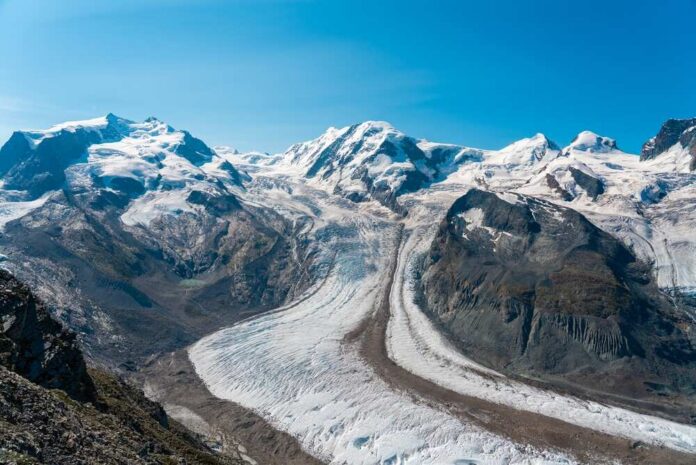
That changed on July 26, 2026, when a hiker walking near Saas-Grund spotted two bodies exposed on the surface of the Trift Glacier, close to the Italian border.
A thawing Swiss glacier has given up the bodies of two Belgian climbers who vanished more than three decades ago. Police in the canton of Valais on Wednesday said a hiker spotted… https://t.co/UmLKH15fou
— Newser (@Newser) August 19, 2026
Regional police in the canton of Valais confirmed the discovery and moved quickly to recover the remains. Investigators transported the bodies to the Institute of Forensic Medicine at Wallis Hospital in Sion, where specialists began the work of identification.
Reports from Belgian outlets noted that identification documents were found near the remains, offering an early clue before DNA work confirmed it.
DNA Testing Closes A Case Three Decades In The Making
Swiss authorities announced on August 19, 2026, that DNA comparison confirmed the identities of the two men found on the Trift Glacier as Bastyns and Van Deun.
Swiss broadcaster SRF reported that Valais state police identified the pair after collating and analyzing genetic material from the remains recovered in July. The confirmation gave both families something they had waited 34 years for: certainty.
Belgian newspaper Het Laatste Nieuws reported that families first received word at the end of July that the recovered bodies might belong to the missing men, though DNA testing was still pending confirmation at that time.
That gap between the initial discovery and the final identification is a normal part of forensic process, not a sign of doubt about what happened.
Why Retreating Ice Keeps Giving Up The Missing
This case is not an isolated event. Swiss glaciers have surrendered a steady stream of long-lost climbers, soldiers, and wreckage as warming temperatures cause the ice to thin and retreat.
A German climber missing since 1986 was identified this way near the Matterhorn in 2023, after 37 years frozen in place. A married couple missing since 1942 turned up on the Tsanfleuron glacier decades later, remarkably preserved by the cold.
Researchers who study these discoveries say the pattern will likely continue. Swiss police have warned that hundreds of mountaineers who vanished in the Alps over the past century could eventually surface as glaciers keep shrinking.
Each recovery requires careful, swift handling once remains are exposed, since forensic scientists note that thawed bodies degrade quickly and must be documented and preserved before evidence is lost.
What The Discovery Means For Families Left Waiting
For the loved ones of Bastyns and Van Deun, the discovery replaces decades of uncertainty with an answer, however difficult.
Missing-person cases without remains often leave families in a painful limbo, unable to grieve fully or close the chapter. Swiss forensic identification through DNA gives these two families exactly what closure requires: verified facts, not speculation.
The remains of two Belgian climbers who vanished in 1992 have been found in Swiss Alps after a hiker in July reported finding the bodies on the Trift glacier in Switzerland https://t.co/695XjuwUzw
— TRT World (@trtworld) August 19, 2026
The Trift Glacier case now joins a growing list of Alpine recoveries that show how shrinking ice, while a stark marker of a warming climate, has also become an unexpected tool for resolving old tragedies.
Investigators in Valais closed one file this month. Given how many climbers over the past century never came home, it likely will not be the last.
Sources:
snowbrains.com, nampa.org, 20min.ch, newser.com, nn.ru, incidentia.ru, bharian.com.my, dhnet.be