
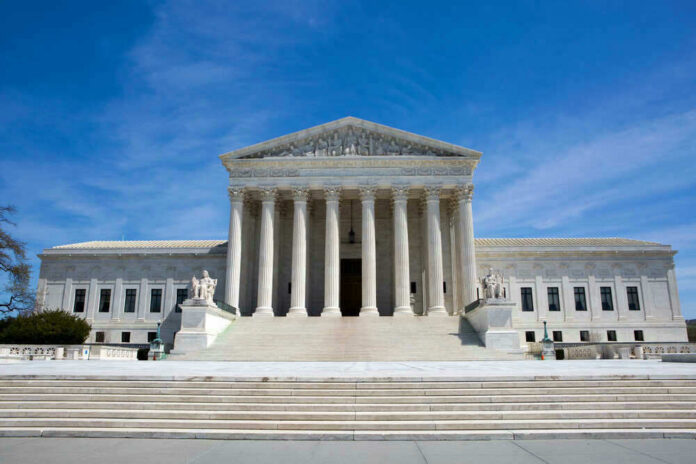
Republican voters just delivered the Supreme Court its worst approval numbers on record, and the drop happened in a single year.
Story Snapshot
- Gallup finds only 33% of Americans approve of the Supreme Court, a record low, while 61% disapprove.
- Republican approval of the Court fell to 58% from 79% in the prior measurement, driving the overall decline.
- The drop follows 2026 rulings against President Trump on tariffs, birthright citizenship, and Federal Reserve leadership.
- Other surveys, including Washington Post-Ipsos and Economist/YouGov polls, show similar low approval and ideology concerns.
A Historic Drop in Republican Confidence
Gallup’s new numbers mark a turning point most Americans haven’t fully absorbed yet. Just 33% approve of the Court’s work, down six points from last year’s 39%, itself a prior record low. Disapproval hit 61%, also a new high. The real story sits inside those numbers: Republican approval collapsed from 79% to 58%, while Democrats and independents barely moved.
Supreme Court approval hits record low as Republicans' support declines https://t.co/3aEWQziDNn
— CNBC Politics (@CNBCPolitics) July 28, 2026
That kind of one-party swing doesn’t happen by accident. It happens when a base that expected wins keeps getting handed losses. Conservatives spent years building the current Court majority, expecting rulings that respect the Constitution’s plain text and limit federal overreach. When the Court instead ruled against the president on three major fronts this term, many Republicans felt blindsided.
Three Rulings That Reshaped the Term
The Court’s decision striking down Trump’s sweeping tariff plan came first, with justices ruling 6-3 that the president exceeded his authority by imposing broad “reciprocal” tariffs without clear congressional approval. Then came Trump v. Barbara, where the Court rejected the administration’s effort to limit birthright citizenship, ruling that children born on American soil to noncitizen parents remain citizens under the Fourteenth Amendment. A third ruling touched the Federal Reserve’s independence, adding to a pattern of setbacks for presidential authority over federal agencies.
Each ruling drew support from a mix of justices, not a simple liberal-conservative split, which matters. The birthright citizenship decision, authored by Chief Justice Roberts, grounded its reasoning directly in the Fourteenth Amendment’s text and history. Critics call it activism. Supporters call it originalism doing exactly what conservatives asked for decades: reading the Constitution as written, even when the result frustrates a Republican president’s agenda.
Is This Really About Legal Reasoning, or Just Politics?
Here’s where skeptics push back, and they have a point worth weighing. Gallup’s poll measures opinion, not legal correctness. It doesn’t tell us whether the tariff ruling misread trade law or whether the birthright citizenship decision got the Fourteenth Amendment wrong.
The sharp partisan gap actually suggests something else: Republicans have long approved of the Court at unusually high rates, sometimes 75% versus just 11% for Democrats, meaning this swing may reflect frustration with specific losses rather than a verdict on judicial quality.
That distinction matters for anyone who values the rule of law over short-term political wins. A conservative who believes in constitutional text should welcome a Court willing to rule against its own side when the law demands it. The alternative, a Court that simply rubber-stamps whichever party holds the White House, is the actual threat to legitimacy that Americans across the spectrum should fear.
What the Broader Polling Landscape Shows
Context matters here too. Gallup’s topic tracking shows Court approval has sat in the low 40s since 2021, meaning this isn’t a sudden collapse from a healthy baseline. Pew found favorable views near a three-decade low even before this term’s rulings.
A Washington Post-Ipsos poll found 46% of Americans believe the Court rules on Trump’s policies based on ideology rather than law, a sentiment that cuts both ways depending on which ruling frustrates you.
Supreme Court approval hits record low as Republicans’ support declines – CNBChttps://t.co/GVlY4JpAHY
— Open Outcrier (@OpenOutcrier) July 28, 2026
None of this erases the headline number. A third of the country approving of the nation’s highest court is a genuine problem for institutional trust, regardless of party. But conservatives weighing this moment should ask a harder question than “did we win or lose.”
They should ask whether the Court followed the Constitution. On tariffs, citizenship, and the Fed, the justices offered detailed textual reasoning, not political theater. Approval ratings will recover. Constitutional integrity, once abandoned, rarely does.
Sources:
cnbc.com, news.gallup.com, uspollingdata.com, semafor.com, molawyersmedia.com, pewresearch.org, reuters.com, deseret.com, scotusblog.com