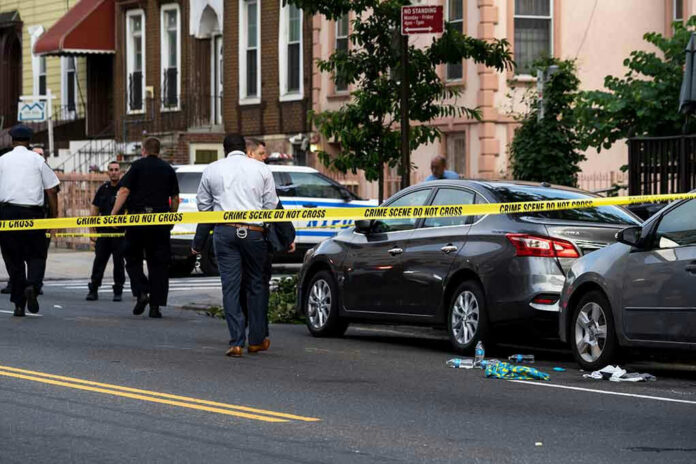
Two teenagers are dead, three worshippers were gunned down outside a California mosque, and once again Americans are being asked to trust early leaks from unnamed officials instead of seeing the evidence for themselves.
Story Snapshot
- Law enforcement sources say 17-year-old Cain Clark and 18-year-old Caleb Velasquez were the shooters in the Islamic Center of San Diego attack, but much of the case rests on anonymous leaks and summaries, not public records.[3]
- Investigators are probing the shooting as a possible hate crime after reports of anti-Islamic writings, “racial pride” language in a suicide note, and Nazi-associated symbols on a weapon and gas can.[2][3][4]
- The two teens allegedly killed three men outside the mosque, then died from apparent self-inflicted gunshot wounds in a nearby BMW, leaving no opportunity for direct denial or explanation.[2][3][4]
- Families, neighbors, and millions of Americans are left with shock, grief, and very few hard documents, reinforcing a familiar pattern where early law-enforcement narratives harden before full transparency arrives.[1][3][4]
What We Actually Know About the San Diego Mosque Shooting
Reports from multiple outlets state that on May 18, 2026, two teenage gunmen opened fire outside the Islamic Center of San Diego, the city’s largest mosque, killing three adult men before fleeing in a vehicle.[3] Police say officers received an active-shooter call around mid-day, arrived within minutes, and found three victims dead near the entrance.[3] Authorities later located a BMW a few blocks away with two deceased males inside, believed to be the suspects, both apparently killed by self-inflicted gunshot wounds.[3][4]
NEW: San Diego Police Chief Scott Wahl revealed that the mother of one of the suspects called authorities before the mosque attack, warning that her son was missing and may have been suicidal.
Wahl said the mother reported multiple weapons missing, her vehicle gone and that her… pic.twitter.com/u1nct3RFOu
— Fox News (@FoxNews) May 19, 2026
Law enforcement officials and news organizations identify the suspects as 17-year-old Cain Clark and 18-year-old Caleb Velasquez (spelled Vazquez in some reports), both San Diego area residents.[3][4] Clark is widely described as a former standout wrestler connected to Madison High School, a detail that has shocked classmates and neighbors who saw him as quiet and helpful.[2] Because one suspect was a minor, juvenile privacy rules may limit how much official documentation will reach the public, at least in the near term.[3][4]
Early Evidence of Hate Motive—and Its Limits
Officials are investigating the attack as a possible hate crime, citing several pieces of reported evidence.[3] Summaries of law-enforcement briefings say investigators recovered anti-Islamic writings and hate-filled messages on the suspects’ weapons and inside their vehicle.[2] A law enforcement source also told reporters that at least one suspect left a suicide note referencing “racial pride.” Another account says officers found a shotgun and a gas can bearing an “SS” sticker, which appears to reference the Nazi Schutzstaffel organization.[3][4]
These details understandably fuel public outrage and fear, especially among Muslim Americans who have seen houses of worship targeted before.[3] At the same time, virtually all of this hate-crime evidence comes to the public secondhand, through unnamed sources or paraphrased summaries, not through released photographs, affidavits, or crime-lab reports.[2][3][4]
No charging document exists because the suspects are dead, and no court has scrutinized the claims. That gap between dramatic allegation and hard documentation is exactly where distrust of institutions grows on both left and right.
A Mother’s Warning, Missing Guns, and Questions About Prevention
Several reports say one suspect’s mother called police hours before the shooting, warning that her son was suicidal and that multiple firearms were missing from her home.[2][4] Officers allegedly elevated their internal threat level and began looking for the teen, but the attack unfolded before they could intervene.[2]
Law enforcement sources say at least one suspect stole weapons from a parent, which appears to match the mother’s report, although the full 911 recording and dispatch logs have not yet been released to confirm timelines or wording.[2][4]
For many Americans, that sequence hits a nerve. Parents across the spectrum worry that even when they do the “right” thing—calling authorities about a troubled child with access to guns—the system responds slowly, inconsistently, or opaquely. Conservatives see a government that fails at basic public safety while obsessing over bureaucratic priorities.
Liberals see a system that can mobilize endless resources for surveillance or foreign wars, yet still cannot coordinate mental-health responses and firearm controls in time to prevent local tragedies. Both sides wonder what, exactly, all this government is doing with the power and money it already has.
How Narrative Gets Ahead of Evidence—and Why That Matters
Coverage of this shooting fits a familiar pattern in high-profile attacks involving alleged hate motives.[3] Early information flows almost entirely from law-enforcement leaks to favored outlets, which then get rapidly recycled by television segments, online videos, and social media posts.[1][2][3] The core story—here, that two radicalized teens carried out an anti-Muslim, racially charged attack—can congeal in the public mind long before anyone outside the investigative circle sees forensic evidence, digital records, or sworn statements.[3]
Two alleged shooters in the deadly attack outside the Islamic Center of San Diego have been identified as Cain Clark and Caleb Velasquez.
The suspects were reportedly found dead nearby after the shooting, as investigators examine anti-Islamic writings and possible hate-crime…
— Erik Hoffmann (@TheErikHoffmann) May 19, 2026
That does not mean the officials are lying; most of their early narrative may prove accurate once documents emerge. But when a system that many already view as captured by elites demands “trust us” after every crisis, without prompt and verifiable disclosure, skepticism is rational.
People across the political spectrum want answers: the complete incident report, body-camera footage, ballistics and autopsy findings, the text of any suicide note, and proof about online radicalization.[3][4] Until those records are public, the San Diego mosque shooting will remain both a personal tragedy and another test of whether America’s institutions still believe citizens deserve the whole truth.
Sources:
[1] YouTube – Green-Haired Mosque Shooting Suspect Would Help …
[2] YouTube – Who Is Cain Clark? Star Wrestler Linked To DEADLY San Diego …
[3] Web – 2026 Islamic Center of San Diego shooting – Wikipedia
[4] Web – Who were Cain Clark and Caleb Vazquez? San Diego mosque …