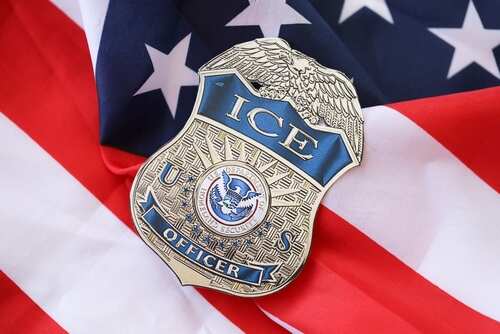
Prosecutors now say video evidence dismantled the original story—and an Immigration and Customs Enforcement agent is the one facing assault and false-reporting charges.
Story Snapshot
- State prosecutors charged Immigration and Customs Enforcement agent Christian Castro with four counts of assault and falsely reporting a crime [1][5].
- Federal prosecutors dismissed the original case against two Venezuelan men, citing newly discovered video that contradicted officers’ sworn accounts [1][3].
- Federal authorities reportedly opened a perjury probe into two officers; Immigration and Customs Enforcement leadership acknowledged testimony appeared untruthful [2].
- The case highlights how quick official narratives can collide with later-revealed evidence, especially when third-party video exists [1][2][3].
Charges Against an Officer Upend the Original Narrative
Hennepin County prosecutors filed assault and false-reporting charges against Immigration and Customs Enforcement agent Christian Castro after reviewing evidence from a January 14, 2026 shooting in Minneapolis. Reporting describes four assault counts and a separate allegation that Castro falsely reported a crime, signaling prosecutors believe the officer’s conduct and statements crossed legal lines [1][5].
Without the charging complaint, the precise factual basis for each count is not public here, but the decision to charge followed a major evidentiary realignment [1].
An ICE agent who shot a Minneapolis man in the leg has been charged with 4 counts of assault. pic.twitter.com/wyWp0XtQml
— FactPost (@factpostnews) May 18, 2026
Federal prosecutors moved to dismiss earlier assault charges against two Venezuelan defendants after “newly discovered” surveillance video contradicted sworn testimony used to justify the initial case [1][3].
The United States Attorney’s Office cited material inconsistencies between the original allegations and the video record, a stark reversal that shifted suspicion toward the officers’ accounts and away from the civilians first accused [1][3]. That procedural turn is rare; it usually signals evidence that prosecutors view as devastating to the original theory.
Video Evidence and a Perjury Probe Change the Stakes
The Los Angeles Times reported that federal authorities opened a perjury investigation into two Immigration and Customs Enforcement officers after their testimony conflicted with video evidence [2].
Immigration and Customs Enforcement Director Todd Lyons publicly stated that sworn testimony by two officers “appears” untruthful, an unusual admission from agency leadership that further eroded confidence in the initial report [2]. Prosecutors and a local outlet also referenced surveillance video they considered materially inconsistent with the officers’ claims, raising immediate credibility concerns [3].
Fox 9 attributed the dismissal of the original charges to the newly discovered footage and quoted a family statement alleging the shot came through a closed door, not in response to a broom or shovel attack as initially alleged [3].
That family framing is advocacy, not proof, but it tracks with prosecutors’ statements about contradictions between testimony and video [3]. If neutral video disproves elements of sworn statements, the legal and moral posture flips from deference to scrutiny.
How Conservative Principles Assess Conflicting Accounts
Limited government and equal justice require skepticism toward any official account that clashes with objective evidence. Prosecutors carry the burden to vet claims, disclose exculpatory material, and correct the record when new facts emerge. Their decision to dismiss the initial case—paired with agency acknowledgment of seemingly untruthful testimony—aligns with due-process norms and the rule of law [1][2][3].
If the assault and false-reporting charges against Castro hold up, they reinforce an essential accountability message: authority must answer to facts, not the other way around.
Breaking news: Minnesota prosecutors issued a warrant for the arrest of an ICE agent who allegedly shot a Venezuelan immigrant during the federal government’s enforcement surge in Minneapolis this year.
The agent faces multiple felony assault charges. https://t.co/smgKPeHvmx
— The Washington Post (@washingtonpost) May 18, 2026
Caution still matters. The available reporting does not include the full charging affidavit against Castro, the case number, or a forensic reconstruction of the shot path and door status. Those missing pieces will determine whether the assault elements and the false-reporting allegation can be proven beyond a reasonable doubt [1][3].
Until then, the strongest conclusions rest on what is on the record: prosecutors reversed course after seeing video, Immigration and Customs Enforcement leadership questioned officers’ honesty, and a perjury probe is reportedly underway [1][2][3].
What to Watch Next
Watch for the release of the criminal complaint and supporting affidavits to clarify the legal theory behind each assault count and the false-reporting charge. Look for any body-worn camera, dash camera, or building surveillance synchronized with timestamps to show door position, distance, and timing of the shot.
Monitor the perjury investigation’s outcomes and any internal discipline within Immigration and Customs Enforcement. The simple test applies: if the video and forensics match the prosecutors’ new posture, public trust improves; if not, accountability demands another hard look [1][2][3].
Sources:
[1] YouTube – DOJ drops charges against men accused of assaulting ICE agent …
[2] Web – Feds open a perjury probe into ICE officers’ testimony … – LA Times
[3] Web – ICE agents accused of lying about Minneapolis shooting under oath
[5] YouTube – ICE agent charged in Minneapolis shooting