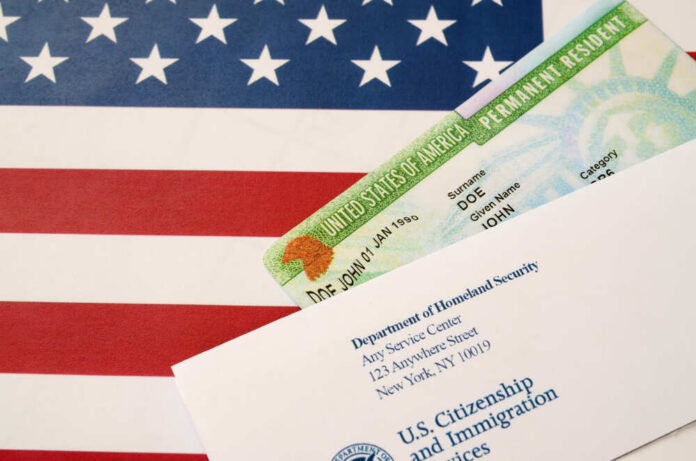
The Supreme Court just told millions of green card holders that a mere accusation can drop them into immigration limbo.
Story Snapshot
- A 6-3 Supreme Court ruling backed Trump’s team over a longtime green card holder accused of counterfeiting[5]
- Border officers no longer need “clear and convincing” proof of a crime to treat a returning resident as an applicant for admission[6]
- The Trump administration argued that suspicion alone is enough to put a lawful permanent resident on immigration parole[5]
- Dissenting justices and advocacy groups warn this looks like a “blank check” for government power over legal immigrants[12]
The case that quietly changed the rules for green card holders
The case began like something that could happen to any frequent traveler with a green card. In 2012, Muk Choi Lau, a lawful permanent resident, flew back from a short trip to China. At the time, he faced accusations of a counterfeiting crime in New Jersey.
A border officer decided not to simply admit him as a returning resident. Instead, the officer placed Lau on immigration parole, a status that lets you enter physically but treats you legally like you are asking to come in[5].
Supreme Court sides with Trump admin in green card holders immigration case https://t.co/qQtteQfX2Z pic.twitter.com/XN5A5FAncj
— New York Post (@nypost) June 23, 2026
Lau later pled guilty to selling counterfeit clothes. That plea gave the Department of Homeland Security an easier way to try to remove him from the country. Lau fought back, arguing the officer had no legal right to treat him like a fresh applicant for admission based only on accusations.
He said that move stretched the law and opened the door for removal that would not have been possible if he had been treated as a normal returning resident[5].
What the Supreme Court actually decided in Lau’s case
The Supreme Court sided with the Trump administration in a 6-3 ruling split along familiar ideological lines[5]. Justice Clarence Thomas wrote the majority opinion. He said border officers did not need “clear and convincing evidence” that Lau committed a crime involving moral turpitude before they could treat him as an applicant for admission[5][6].
In plain English, officers at the border do not have to meet a high courtroom-style proof standard when they make quick calls about returning green card holders.
The Court leaned on the Immigration and Nationality Act. Thomas said nothing in that law forced officers to hit a special proof bar before acting. He warned that adding such a rule from the bench would slow down officers who must make decisions “on the spot” at ports of entry[6].
The ruling left one big issue open. The Court did not decide whether Lau’s counterfeiting conviction is truly a crime involving moral turpitude under immigration law. That question went back to lower courts, which means the core label on Lau’s conduct is still not fully settled[6][8].
Trump’s suspicion standard and the new power over legal residents
Trump’s lawyers took a very aggressive position. They argued that suspicion of a crime is enough to place a lawful permanent resident on immigration parole[5]. That matters because parole sounds harmless, but legally it changes everything.
On parole, a person stands as if they were at the border asking to come in. That can strip long-time residents of protections they thought they had earned, and it makes removal easier if the government later proves a qualifying offense.
Federal attorneys pushed the Court to adopt a broad view of executive power in immigration. They said officers need flexibility to act fast when they see signs of criminal activity, even if the case is not yet proved in court[5]. From a law-and-order perspective, that argument aligns with common sense: do not force border agents to ignore obvious red flags.
Still, critics respond that suspicion is a low bar and that green card holders, who followed the rules to live here legally, deserve more concrete evidence before the government downgrades their status.
Why the dissent and advocates warn about a “blank check”
Justice Ketanji Brown Jackson wrote a sharp dissent, joined by two colleagues[5][12]. She said putting Lau on parole before any conviction trapped him in “immigration limbo.”
Her concern was simple: when the government can change your legal footing based on accusations, you live under a cloud for years while your case moves through both criminal and immigration systems. Advocacy groups echoed that fear, calling the ruling an “expanded path for revoking green cards” that could reach far beyond Lau[12].
Do you understand how important this ruling is?
This just massively sped up the “process” of deportation.
“A federal appeals court handed President Donald Trump a significant win in his mass deportation efforts with a ruling Tuesday reviving his administration’s move to speed…
— JoeLange (@JoeLange) June 23, 2026
Alliance for Justice and other liberal organizations now frame the decision as part of a larger trend of courts deferring to broad executive control in immigration. They warn that future administrations can use this extra power not only against serious offenders, but in ways that feel political or unfair.
The key test will be how often this tool is used and whether it truly targets dangerous actors rather than people who simply made minor mistakes or angered the wrong official.
What this means for ordinary green card holders watching the headlines
A green card has always meant strong, but not absolute, security. This ruling makes that difference clearer. Green card holders who leave the country while under criminal investigation now face real risk at reentry.
A border officer can place them on parole based on alleged offenses, and that decision does not require courtroom-level proof at that moment[5][6]. The underlying criminal case still matters, but the first critical choice now rests with an officer using a suspicion standard.
For many Americans, that sounds tough but fair: if you are facing serious charges, expect extra scrutiny. For legal immigrants, it is a warning label. Travel while under accusation can change your legal footing the instant you hit the inspection line.
The Supreme Court has told us who holds the power at that moment, and it is not the judge, not the jury, and not Congress. It is the officer at the border, backed by a presidency that asked for broader authority and got it.
Sources:
[5] Web – The Supreme Court unanimously ruled that the Department of …
[6] Web – Cases – Permanent residence – Oyez
[8] YouTube – What it Means for Your Removal Case [With Live Q&A]
[12] Web – Lau v. Bondi, No. 21-6623 (2d Cir. 2025) – Justia Law