The Supreme Court has just blocked President Trump from sending the National Guard into crime-ravaged Chicago, siding instead with sanctuary-state politicians and narrowing the president’s ability to enforce immigration law.
Story Snapshot
- The Supreme Court rejected Trump’s bid to deploy National Guard troops to Chicago to support an immigration crackdown.
- Illinois’ Democrat leadership celebrated the ruling as a “win for democracy” and a check on presidential power.
- The Court leaned on the Posse Comitatus Act to say Trump lacked authority to use troops for law enforcement in Illinois.
- Conservative justices dissented, warning about tying the president’s hands as crime and illegal immigration surge.
Supreme Court Blocks National Guard Deployment to Chicago
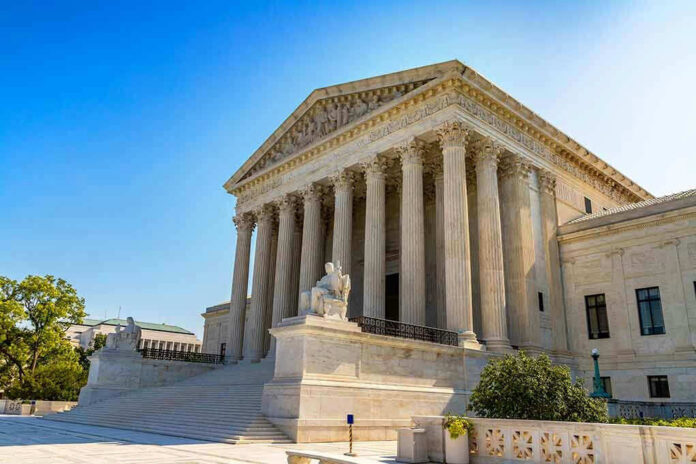
On December 23, 2025, the Supreme Court declined President Trump’s request to overrule a lower court and allow National Guard deployment to the Chicago area over opposition from Illinois officials.
The administration had sought intervention after a district judge blocked plans to send troops in support of an immigration crackdown and to help secure federal personnel and facilities. The high court’s refusal keeps that lower-court order in place, at least for now, preventing additional Guard forces from being sent into Chicago.
The ruling is an early but significant setback for a president who campaigned on restoring law and order after years of lenient border policies, sanctuary cities, and rising crime under left-leaning leadership.
Trump officials argued the Guard presence was needed to back federal law enforcement in enforcing immigration laws and protecting federal property. They emphasized that the mission was focused on shielding officers and infrastructure from violent actors, not turning the Guard into a national police force patrolling city streets.
Supreme Court won’t allow National Guard deployment to Chicago in major loss for Trumphttps://t.co/65uZnnZopl
— The Hill (@thehill) December 24, 2025
Illinois Democrats Claim “Win for Democracy” While Crime Persists
Illinois Governor JB Pritzker quickly celebrated the decision, calling it “a big win for Illinois and American democracy,” and framing it as a check on what he described as the Trump administration’s “abuse of power” and march toward “authoritarianism.”
Those remarks fit a familiar narrative from Democrat leaders who paint virtually any strong federal enforcement move as a threat to democracy, even as their own cities struggle with crime, overwhelmed services, and the costs of years of lax immigration enforcement.
For conservative readers watching Chicago’s ongoing struggles, the political contrast is stark. A president attempting to back up federal agents and enforce immigration law is cast as dangerous, while state and local leaders who resist cooperation with federal authorities are hailed as defenders of freedom.
Many will see this as yet another instance where the concerns of law-abiding citizens—particularly those in working-class neighborhoods bearing the brunt of crime and illegal activity—are subordinated to ideological battles over federalism and progressive priorities.
Posse Comitatus and the Court’s Reasoning
The Court grounded its decision in the Posse Comitatus Act, which generally bars the use of the military in domestic law enforcement unless clearly authorized by Congress or the Constitution.
In its unsigned order, the majority said the government had not, at this preliminary stage, identified a valid legal basis for using the Guard to “execute the laws” in Illinois. The ruling does not permanently resolve the issue, but it effectively freezes Trump’s Chicago deployment plans while litigation continues in the lower courts.
Presidents do have established authority to deploy the National Guard and other forces under certain statutes, particularly to protect federal functions, facilities, and personnel.
Trump has already used that authority to send Guard units to Washington, D.C., Los Angeles, and Portland, moves that were fiercely opposed by blue-state officials and triggered multiple lawsuits.
The Chicago case extends that broader legal and political fight over how far a president can go in using military-adjacent forces to restore order when local leaders refuse to act or openly obstruct federal enforcement efforts.
Conservative Dissents Warn of Weakened Executive Authority
Justices Samuel Alito, Clarence Thomas, and Neil Gorsuch dissented from the Court’s decision, signaling deep concern over narrowing presidential authority in the face of real-world security and immigration threats.
Their dissent aligns with a long-standing conservative view that the executive branch must retain sufficient power to faithfully execute federal law, especially when states adopt policies that directly undercut national immigration enforcement, border security efforts, and the protection of federal operations on the ground.
Justice Brett Kavanaugh authored a concurring opinion, indicating some shared skepticism about the administration’s specific legal theory in this case while still leaving room for a future, better-grounded assertion of authority.
For conservatives, the lineup highlights a difficult tension: defending constitutional limits on domestic military use while also recognizing that activist governors and mayors are using every legal tool available to block federal law enforcement, particularly on immigration, even as they tolerate or downplay the consequences in their own communities.
Ongoing Legal Battles Over Federal Power and Blue-City Resistance
The Chicago dispute is part of a broader wave of litigation sparked by Trump’s deployments of the Guard to left-leaning cities in recent months.
Those deployments, often aimed at protecting federal buildings or reinforcing overwhelmed federal officers, have drawn lawsuits from Democrat governors like California’s Gavin Newsom and from local leaders in Washington, D.C.
Each case tests the balance of power between a federal government charged with enforcing national law and state or city leaders intent on shielding their jurisdictions from stricter enforcement.
For many conservatives, the Court’s latest ruling raises an unsettling question: if a president cannot rely on the National Guard, even in a supporting role, when hostile local officials refuse to cooperate, how can Washington realistically secure the border, protect federal facilities, and confront organized criminal networks operating in and through sanctuary jurisdictions?
As legal battles continue, that unresolved tension will shape how effectively the Trump administration can deliver the law-and-order agenda voters demanded after years of chaos, open borders, and soft-on-crime policies.