
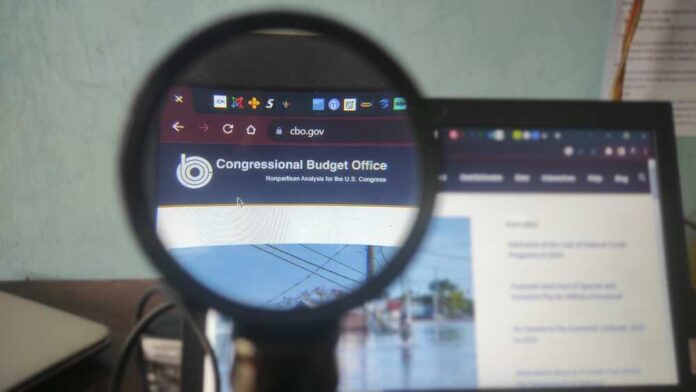
The CBO claimed that President Trump’s “One Big Beautiful Bill Act” would add $2.4 trillion to the deficit, but the President and Republican leaders assert the analysis is wrong as it ignores key economic growth factors.
House GOP leaders insist the sweeping tax and spending plan provides critical tax relief for Americans while tackling illegal immigration and wasteful government spending.
The Congressional Budget Office (CBO) analyzed the comprehensive bill passed by the House last month, which Trump strongly supported.
It proposes $3.7 trillion in tax cuts while reducing spending by $1.2 trillion over the next decade.
It also extends Trump’s successful 2017 tax cuts for individuals and adds new breaks, including eliminating taxes on tips.
House Majority Leader Steve Scalise (R-LA) immediately challenged the CBO’s findings, pointing out their history of inaccurate predictions.
“When it comes time to make prognostications on economic growth, they’ve always been wrong,” Scalise said, highlighting how the analysis fails to account for the economic boom that would result from these pro-growth policies.
White House budget director Russell Vought also defended the bill against the CBO’s dire predictions.
“It includes $1.7 trillion in mandatory savings, the most in history. If you care about deficits and debt, this bill dramatically improves the fiscal picture,” Vought stated, emphasizing the bill’s fiscal responsibility.
Unlike the wasteful spending bills pushed by Democrats, Trump’s plan includes $350 billion for border security, deportations, and strengthening national security.
The legislation also implements common-sense reforms, such as new work requirements for Medicaid and SNAP benefits.
This ensures that able-bodied Americans contribute to society rather than become dependent on government handouts.
The bill faces its next hurdle in the Senate, where President Trump has called for passage by the Fourth of July.
Some GOP senators, including Rand Paul and Ron Johnson, have voiced concerns about deficit impacts, with Johnson going so far as to call the bill “grotesque” and “immoral” in its current form.
Democrats predictably attacked the bill with their usual class warfare rhetoric.
Senate Minority Leader Chuck Schumer claimed Republicans “just want to strangle health care.”
At the same time, Rep. Brendan Boyle (D-PA) called it a “bill for billionaires” – the same tired arguments liberals use whenever conservatives try to let hardworking Americans keep more of their own money.
The CBO, which is notorious for underestimating the positive economic effects of tax cuts, claims the bill would result in 10.9 million more uninsured people by 2034.
Yet, conservatives point out that removing people from government dependency programs is not the same as losing healthcare access – it is about restoring personal responsibility.
As the bill moves to the Senate, Trump allies are pushing for passage through reconciliation, which would require only a simple majority rather than the 60 votes needed to overcome a filibuster.
This strategy would prevent Democrats from blocking key provisions that would strengthen America’s economy.