The first American-born pope delivered a carefully worded Easter message that called for peace but conspicuously avoided naming the United States in its ongoing war with Iran, raising questions about diplomatic constraints on spiritual leadership during a critical moment for global Christians.
Story Snapshot
- Pope Leo XIV celebrated his inaugural Easter Mass on April 5, 2026, calling for global peace while the U.S.-Israeli war with Iran enters its second month
- The pontiff’s Easter homily explicitly condemned war and violence, but his formal “Urbi et Orbi” blessing notably avoided naming specific conflicts
- Religious observances in Jerusalem have been severely restricted by Israeli authorities, with church leaders barred from celebrating at sacred sites
- The first U.S.-born pope faces the diplomatic challenge of addressing American military action while maintaining Vatican neutrality
Historic Easter Mass Marked by Diplomatic Silence
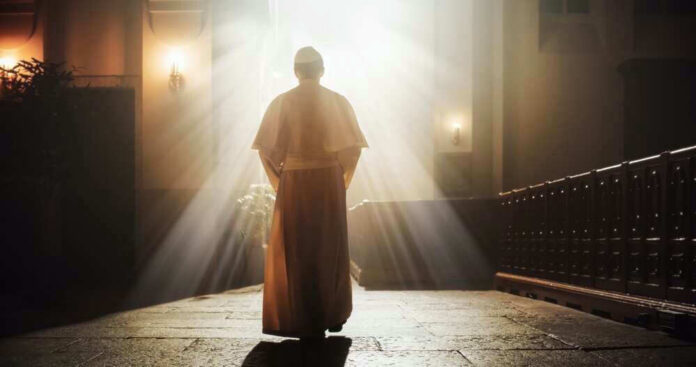
Pope Leo XIV presided over his first Easter Mass as pontiff at St. Peter’s Square on April 5, 2026, baptizing ten adults from around the world amid spring flowers symbolizing hope. The ceremony came as the U.S.-Israeli war on Iran entered its second month and Russia’s campaign in Ukraine continued.
While the pope’s homily contained strong language about nonviolence and war’s destructiveness, his traditional “Urbi et Orbi” blessing delivered to Rome and the world notably refrained from identifying these specific conflicts by name, marking a conspicuous departure from his earlier explicit calls for peace.
In his traditional "Urbi et Orbi" blessing, Pope Leo XIV warned against complacency in the face of relentless violence https://t.co/SigeRdadrR
— DW News (@dwnews) April 5, 2026
Strong Words on War Contrast With Formal Restraint
During his Easter homily, Pope Leo declared that “the power with which Christ rose is entirely nonviolent,” emphasizing that genuine strength fosters “respectful relationships at every level: among individuals, families, social groups, and nations.” The pontiff condemned “the violence of war that kills and destroys” and “the idolatry of profit that plunders the earth’s resources.”
On Palm Sunday, Leo had stated that God does not listen to the prayers of those who wage war or cite God to justify violence. However, this forceful rhetoric during the homily stood in stark contrast to the apparent generality of his formal blessing, suggesting diplomatic considerations may be constraining his public messaging.
American Pope Faces Unprecedented Diplomatic Dilemma
As the first U.S.-born pontiff, Pope Leo XIV occupies a uniquely challenging position as American forces engage in active combat operations against Iran. The Vatican has historically positioned itself as a neutral mediator in global conflicts, but Leo’s national origin complicates this traditional stance.
His reluctance to name the United States in his formal Easter blessing, while repeatedly calling for peace in less formal settings, reveals the tension between spiritual leadership and diplomatic protocol. For conservative Americans who value both patriotism and religious freedom, this raises legitimate questions about whether international institutions constrain moral clarity when American interests are involved.
Religious Freedom Under Siege in Conflict Zones
The practical impact of ongoing conflicts extends beyond diplomatic messaging to the fundamental exercise of religious liberty. Israeli authorities have severely restricted public gatherings in Jerusalem, preventing Latin Patriarch Pierbattista Pizzaballa from celebrating Palm Sunday at the Church of the Holy Sepulchre due to security concerns and ongoing missile attacks.
Traditional ceremonies at Christianity’s holiest sites have been scaled back, affecting Christian, Muslim, and Jewish observances alike. These restrictions demonstrate how security measures in conflict zones directly erode the religious freedom that conservatives rightly view as foundational. The precedent being set threatens long-term access to sacred sites and interfaith cooperation.
Vatican Diplomacy Versus Moral Clarity
Pope Leo’s Easter message reflects the Vatican’s institutional preference for maintaining diplomatic relationships with all parties, even when specific moral condemnation might be warranted. The distinction between his pointed homily remarks and the more measured “Urbi et Orbi” blessing suggests traditional protocols limit how directly popes can address geopolitical realities in formal settings.
While diplomatic engagement has value, conservatives should scrutinize whether such restraint serves truth and justice or merely preserves institutional influence. The pope’s emphasis on nonviolence, while spiritually grounded, offers limited practical guidance for nations facing genuine security threats or defending allies against aggression, underscoring the gap between religious idealism and geopolitical reality.
Sources:
Photos show Pope Leo’s first Easter Mass as pontiff – Crux Now
Pope Leo calls for hope amid conflicts first Easter – CBS News