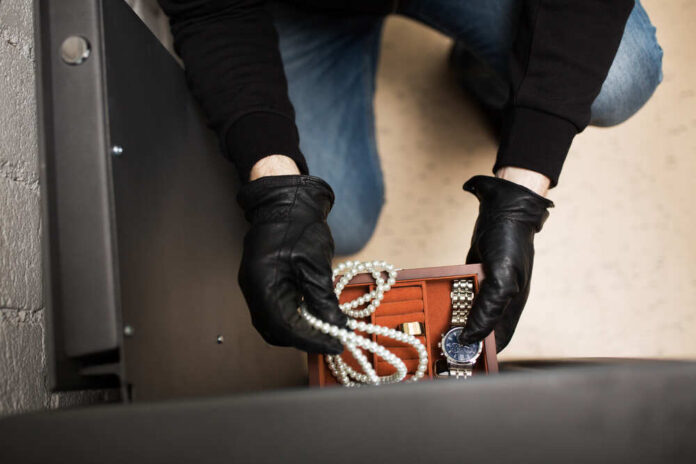
In a bold heist that has left many scratching their heads, skilled thieves stole $1.3 million in jewelry from a store.
The sophisticated thieves deployed professional equipment and techniques to cut through a wall and directly into a jewelry safe.
The high-stakes robbery took place at a South Barrington jewelry store in Illinois on Mother’s Day.
The thieves made off with approximately 1,000 pieces of jewelry, roughly 90% of the store’s entire inventory.
The burglars gained access by breaking through the wall of a vacant office adjacent to the jewelry store, then used specialized equipment to cut directly into the store’s safe.
Store owner Rick Kleinvehn is convinced this was not random criminal activity but rather a meticulously planned operation potentially involving inside information.
“There’s got to be someone who told them exactly where that safe was. Nobody knew where our safes were located,” Kleinvehn stated about the hidden safe locations.
The criminals demonstrated sophisticated planning by cutting the internet connection to the entire office complex and stealing both the store’s new security system and digital video recorder.
The heist occurred over Mother’s Day weekend when the store was closed, giving the thieves nearly five uninterrupted hours to complete their operation.
The criminals’ equipment and tactics point to professional expertise rather than opportunistic theft.
The store owner explained:
“They used a wet saw, and the interior where the safe was became all slushy, muddy, just kind of a goo on the floor from them cutting for hours and hours through that steel. They had buckets, and they were filling buckets and pouring it on the hot metal.”
“It was people that had the equipment and knew exactly what they were doing,” he noted.
Kleinvehn is offering a substantial $25,000 reward for information leading to arrests and an additional $50,000 if the jewelry is recovered.
Meanwhile, the FBI has joined local police in the investigation. Yet, no suspects have been identified or apprehended, continuing a troubling pattern of law enforcement struggling to combat organized crime effectively.
“I was devastated. We have a great staff here. We all work very hard and we travel across the country constantly, and to replace everything in there is tens of thousands of hours of work. It’s a lot of lost time and money,” Kleinvehn added.
A similar heist occurred approximately two weeks later in Simi Valley, California, where thieves broke into a candy store to access an adjacent jewelry store.
Though authorities claim no evidence links the two burglaries, the timing and similar methods raise questions about potential connections between these sophisticated criminal operations targeting small businesses across multiple states.
This robbery represents more than monetary loss for hardworking business owners like Kleinvehn.
It is a devastating blow requiring thousands of hours to rebuild inventory that was accumulated through years of legitimate work, while criminals with apparent inside knowledge walk free with millions in stolen goods.