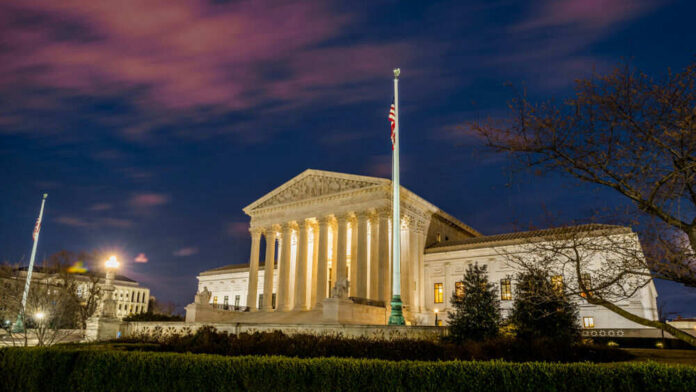
The Supreme Court just delivered a unanimous rebuke to federal court manipulation that stripped Texas parents of their right to hold baby food companies accountable in their home state, exposing a corporate legal scheme that denied a family justice after their child allegedly suffered devastating developmental damage from toxic heavy metals.
Story Snapshot
- The Supreme Court ruled 9-0 on February 24, 2026, that Hain Celestial Group improperly removed a Texas baby food poisoning case to federal court by falsely dismissing Whole Foods as a defendant
- Texas parents Sarah and Grant Palmquist can now pursue claims against both Hain and Whole Foods in state court after their child allegedly developed severe disorders from heavy metals in baby food
- The ruling closes a corporate loophole that allowed manufacturers to dodge state courts by manipulating federal jurisdiction rules, restoring power to citizens seeking accountability
- A 2021 congressional report exposed dangerous levels of arsenic and lead in multiple baby food brands, sparking nationwide litigation that corporations attempted to control through forum shopping
Corporate Legal Maneuver Backfires at Highest Court
The Supreme Court unanimously vacated a federal court judgment that favored Hain Celestial Group after the company orchestrated the removal of the case from the Texas state court.
Justice Sonia Sotomayor authored the opinion affirming the Fifth Circuit’s reversal, which held that Hain’s dismissal of Whole Foods—a co-defendant sharing Texas citizenship with the plaintiffs—was erroneous and could not retroactively create federal jurisdiction.
This procedural manipulation allowed Hain to secure a favorable federal venue where it won at trial, effectively denying the Palmquist family their day in Texas court, where both defendants belonged.
Supreme Court unanimously rebukes lower court's handling of Whole Foods baby food case https://t.co/kHw1KwJuRK
— FOX Business (@FoxBusiness) February 24, 2026
Parents’ Nightmare Fuels Fight for Accountability
Sarah and Grant Palmquist fed their child Hain baby food purchased at Whole Foods for the first two-and-a-half years of life. Their child initially developed normally, but after 2021, when a House Oversight Subcommittee report revealed elevated toxic metals, including arsenic and lead, in Hain products, their child was diagnosed with physical and mental conditions.
Some doctors attributed these devastating disorders to heavy-metal poisoning, prompting the parents to file product liability and negligence claims in Texas state court against both the manufacturer and retailer. Their lawsuit alleged Whole Foods breached warranties and misrepresented the safety of products it sold to Texas families.
Federal Courts Wrongly Enabled Forum Shopping
Hain removed the case to federal court by invoking the “improper joinder” doctrine, arguing Whole Foods was fraudulently added as a defendant solely to defeat diversity jurisdiction. The Western District of Texas agreed, dismissing Whole Foods and proceeding with trial against Hain alone despite both Whole Foods and the plaintiffs being Texas citizens.
Federal diversity jurisdiction requires parties from different states and over seventy-five thousand dollars in controversy, a threshold the original lawsuit clearly failed to meet with two Texas-based parties. The district court’s acquiescence gave Hain precisely what it sought: escape from state court oversight and a federal judgment in its favor.
Ruling Slams Door on Jurisdictional Manipulation
The Supreme Court’s opinion clarified that erroneous dismissal of a properly joined defendant does not cure an initial jurisdictional defect that existed at the time of removal. The Court emphasized that the jurisdictional flaw “lingered through judgment,” invalidating every subsequent federal action including the trial verdict favoring Hain.
This directly contrasts with earlier precedent, where correct dismissals could cure jurisdiction problems, establishing that federal courts cannot create authority they never lawfully possessed. Justice Clarence Thomas filed a separate concurrence questioning whether federal courts have any power to rule on improper joinder at all, potentially signaling future limits on corporate forum-shopping tactics.
The case now returns to the Texas state court with Whole Foods reinstated as a defendant, allowing the Palmquists to finally pursue their claims on the merits in their home jurisdiction.
Legal experts note the ruling tightens standards for federal removal in diversity cases, preventing corporations from manufacturing federal jurisdiction through strategic dismissals.
This precedent particularly benefits Texas and other state plaintiffs facing well-funded corporate defendants who deploy procedural tactics to avoid state courts perceived as more sympathetic to injury victims and consumer protection claims rooted in state law.
Sources:
Supreme Court Update – Dorsey & Whitney LLP
Justices send litigation about tainted baby food back to state court – SCOTUSblog
Supreme Court Opinion No. 24-724 – Hain Celestial Group, Inc. v. Palmquist
High court puts Whole Foods back in hot seat over baby food debacle – Courthouse News
U.S. Supreme Court allows case involving alleged toxic baby food to advance – VitalLaw