
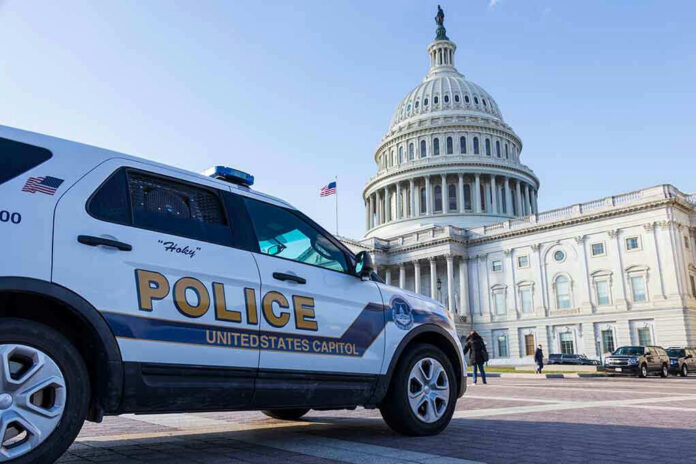
A loaded-shotgun sprint toward the U.S. Capitol is the kind of security breakdown that forces Washington to choose between real protection and political theater.
Story Snapshot
- U.S. Capitol Police say an 18-year-old was detained after running toward the U.S. Capitol carrying a loaded shotgun and wearing a tactical vest.
- Reports indicate officers stopped him before he reached the building; investigators are working to determine intent and any additional threats.
- The incident lands amid wider, post-2025 security upgrades at capitols nationwide, including new screening technology and tighter entry procedures.
- Minnesota’s State Capitol has also rolled out AI-assisted weapons screening at entrances for the 2026 session, reflecting a broader trend toward hardened public buildings.
What Police Say Happened at the U.S. Capitol
U.S. Capitol Police detained an 18-year-old after he ran toward the U.S. Capitol while carrying a loaded shotgun and wearing a tactical vest, according to multiple reports. Officers reportedly intercepted him before he reached the building, preventing any immediate breach of the Capitol itself.
Public reporting emphasizes the weapon was loaded, which elevates the seriousness of the approach and prompts investigators to focus on intent, planning, and whether anyone else was involved.
Man arrested running toward Capitol with shotgun and wearing tactical vest, police sayhttps://t.co/AFLgEkrICu
— Scott MacFarlane (@MacFarlaneNews) February 17, 2026
Early accounts describe a fast-moving encounter where officers acted before the suspect could get closer to the Capitol complex. That is the key operational fact for the public: the stop occurred outside the building, underscoring the importance of perimeter response, officer readiness, and clear lines of sight around high-value targets.
Authorities have not been consistently described in the provided research as releasing a detailed motive or manifesto, so conclusions about ideology or motive remain unsupported here.
Why This Incident Hits a National Nerve in 2026
Federal and state capitols have been tightening security as threats and political tensions remain high. The U.S. Capitol complex has already experienced waves of security changes in recent years, including closures and traffic controls around major events.
For constitutional conservatives, the concern is not the need for security—it is whether leadership can protect public institutions without turning “public access” into a privilege reserved for insiders while ordinary Americans face a maze of barriers to petition government.
The incident also highlights a basic contradiction: officials routinely promise both openness and safety, yet violent or potentially violent episodes push institutions toward heavier controls. When government responds primarily with restrictions on the public rather than targeted enforcement against criminals, distrust grows.
The available reporting in this packet focuses on what police say occurred and the broader security posture, not on policy proposals tied directly to this particular arrest, so any claim that it will produce new federal restrictions would be speculation.
Security Measures Spreading to State Capitols
At the Minnesota State Capitol, new screening measures for the 2026 legislative session illustrate how quickly security technology is becoming normalized. Minnesota’s approach includes AI-powered weapons screening systems at multiple entrances and updated protocols for visitors.
Reporting tied these changes to prior violence against public officials, contributing to a climate where capitols are treated more like airports. The practical impact is clear: more screening, more checkpoints, and less frictionless access to lawmakers.
Those changes are not purely technical; they reshape civic life. Advocates for people with disabilities have raised concerns that certain screening and entry procedures can create added barriers for visitors who already face challenges navigating public buildings.
The policy tension is real: governments must keep staff and visitors safe, but a “secure by default” mindset can quietly erode equal access and transparency. The research provided does not quantify wait times or denial rates, so the scale of access impacts is still uncertain.
What to Watch Next: Enforcement vs. Overreach
Incidents involving firearms near government buildings often trigger calls for broader rules that reach far beyond the offender. Conservatives generally support enforcing existing laws, hardening targets where appropriate, and prosecuting criminal conduct—without letting bureaucracies exploit fear to justify sweeping restrictions on lawful citizens.
The key question is whether officials focus on facts: how the suspect got there, whether there were warning signs, and which security layers worked, rather than using the moment to advance unrelated agendas.
As more capitols add screening and perimeter controls, Americans should demand transparency on results: what threats are being stopped, what procedures actually work, and how public access is being preserved.
The public also deserves clarity on the limits of new technology, including false positives, data retention, and who oversees these systems. The immediate takeaway from this arrest is straightforward: a rapid police interception likely prevented disaster, but it also exposes why security decisions must remain rooted in evidence—not politics.