President Trump’s claim that the opening Iran strikes were “very complete” is colliding with a hard reality: the administration is still preparing for weeks of fighting while Iran targets U.S. bases across the region.
Story Snapshot
- U.S. and Israeli forces launched nearly 900 strikes in about 12 hours on Feb. 28, 2026, targeting Iranian missiles, air defenses, infrastructure, and leadership.
- Trump’s “very complete” language appears aimed at the initial strike phase, even as the White House described a 4–6 week campaign to reach all objectives.
- Iran retaliated with hundreds of missiles and thousands of drones, including strikes aimed at U.S. facilities in multiple Middle East countries.
- A deadly strike hit a girls’ school near a naval base in Minab, killing more than 160 people; Israeli officials denied involvement and the U.S. said it would investigate possible U.S. involvement.
What “Very Complete” Actually Refers To
President Trump’s description of the Iran operation as “very complete” is best read as a judgment on the opening salvo, not a declaration that the conflict is over.
Reports describe a tightly coordinated U.S.-Israel strike package on Feb. 28 that hit Iranian missiles, air defenses, military infrastructure, and senior leadership. In conservative terms, the administration is projecting competence and deterrence—while acknowledging, by its own timeline, that the mission remains underway.
The same set of reporting that highlights the scale of the first wave also points to an extended campaign plan. The White House has described a 4–6 week window to achieve “all military objectives,” and Trump has publicly escalated rhetoric to demands for Iran’s “complete surrender.”
That gap between “very complete” and “weeks remaining” matters because it shapes public expectations—especially for Americans wary of open-ended commitments and vague end states.
Inside Operation Epic Fury: Scale, Targets, and Civilian Risk
Operation Epic Fury began Feb. 28, 2026, with nearly 900 strikes inside roughly 12 hours, a tempo suggesting deep planning and intelligence preparation rather than an improvised response.
Reports say the strikes killed Supreme Leader Ali Khamenei along with other top figures, including Iran’s defense minister and the head of the Revolutionary Guard. Militarily, decapitation strikes can disrupt command and control, but they also raise the stakes for retaliation and escalation.
The conflict also arrived with an immediate moral and strategic test: a missile strike that hit a girls’ school adjacent to a naval base in Minab reportedly killed more than 160 people. Israeli officials denied involvement, and the U.S. said it would investigate potential U.S. involvement.
With more than 1,000 deaths reported overall and mass travel disruption, the civilian toll is not a side note. Legitimacy, coalition cohesion, and the durability of any military gains depend on accountability and clarity.
Iran’s Retaliation and the Risk to U.S. Forces
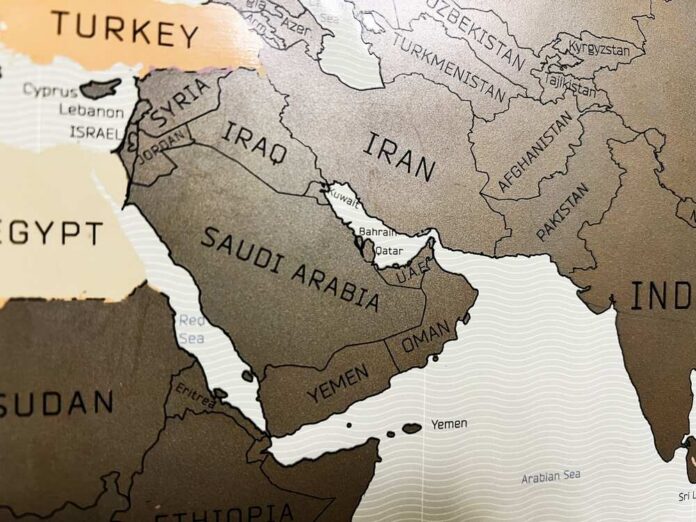
Iran’s response has centered on volume—hundreds of missiles and thousands of drones—spread across a wide regional map. Reports indicate Iranian forces targeted U.S. military bases in Bahrain, Kuwait, the United Arab Emirates, Jordan, Saudi Arabia, and other locations, with IRGC-affiliated media claiming attacks on 14 U.S. bases by early March.
For Americans focused on national defense, this is the core danger: dispersed U.S. personnel and partners become targets even when Washington holds air superiority.
On March 3, 2026, the U.S. military reported a friendly fire incident in which Kuwait shot down three American F-15E Strike Eagles; all six pilots ejected safely and were listed in stable condition.
Even without confirmed combat losses in that episode, it highlights the friction that comes with high-tempo, multi-country operations. Sustained campaigns require not only superior firepower, but disciplined coordination—especially when multiple allies are engaging fast-moving threats.
Strategic Objectives: Deterrence, Nuclear Pressure, and Regime Messaging
U.S. stated objectives reported by military analysts include preventing an Iranian nuclear capability, dismantling missile forces, neutralizing naval assets, and safeguarding U.S. interests against Iran-aligned networks.
The Institute for the Study of War also characterizes the campaign as aimed at toppling the Islamic Republic, aligning with Trump’s eight-minute Feb. 28 video message calling on Iranians to topple their government. That’s a broader objective than a single nuclear file—and it raises the bar for “mission complete.”
Conservatives who value limited government and constitutional accountability will watch how clearly the administration defines success and how it protects U.S. forces while avoiding mission creep.
The available reporting supports a conclusion that the first phase was comprehensive, but it does not provide enough verified detail to confirm how degraded Iran’s remaining capabilities are, or what “complete surrender” would practically entail. The next weeks will likely determine whether early gains become durable outcomes.
Sources:
https://www.britannica.com/event/2026-Iran-Conflict
https://en.wikipedia.org/wiki/2025%E2%80%932026_Iran%E2%80%93United_States_negotiations